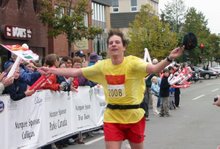
Guardian photo by Brian McInnis
 Thousands walked/ran on the Confederation Bridge Sunday during the Terry Fox event.
BAYFIELD, N.B. — There was a brisk breeze and bright sunshine Sunday as 10,000 walkers and runners crossed the Confederation Bridge, doing their part to raise money for the annual Terry Fox Run — 30 years after Fox’s cross-country trek was tragically cut short.
Fred Fox, Terry’s older brother, was among those who crossed the 13-kilometre span over the Northumberland Strait.
He said it was an emotional moment as the group from the P.E.I. side met the group that started on the New Brunswick side.
“Everybody was cheering everybody on,” he said in an interview afterward, sipping water in the shadow of the bridge on the New Brunswick side.
“It was a pretty cool experience.”
The Terry Fox Foundation says the annual event, which has become one of the largest cancer research fundraisers in the world, has raised almost $500 million over the years.
That money has been used to make important breakthroughs in the fight against cancer, Fred Fox said.
On Sunday, he marvelled at the number of walkers and runners wearing red Terry’s Team T-shirts, signifying they are cancer survivors.
“It’s a testament to how cancer research is working ... People are surviving their cancer and living longer,” he said.
“It’s pretty rewarding when you get people coming up to you and saying, ’I’m a live today because of what Terry did in 1980 ... It’s pretty incredible to hear people express that.”
Fred Fox, only 14 months older than his famous brother, said he was thinking of Terry when he was crossing the bridge.
“We did everything when we were together,” he said. “He liked to stay active and compete all the time... We challenged each other to do our best.”
Many others have followed Terry Fox’s journey from the start, including Bruce Moore, his high school soccer coach.
“He was an average kid who did extraordinary things,” Moore said in an interview, adding that Terry Fox was a gifted athlete who also played basketball and rugby.
“He was a good student who was on the honour role ... But he was very quiet, and always the first one on the field and the last one off. He led by example, rather than make a lot of noise.”
Moore and his family ran in the first September event in 1981 and have taken part or helped to organize every run since then in Fox’s hometown of Port Coquitlam, B.C.
Moore, who’s now 70, was later diagnosed with cancer. He says he strongly believes he’s still alive because of the money raised from the annual runs.
Meanwhile, Terry Fox’s parents, Betty and Rolly Fox, were in southwestern Nova Scotia to take part in three runs. The community of Barrington won a national contest to host the Foxes.
“There are few folk heroes in Canadian history as formidable and inspiring as Terry Fox,” said local councillor Shaun Hatfield.
Terry Fox was diagnosed with a rare form of bone cancer when he was 18. His right leg was later amputated 15 centimetres above the knee.
Three years later, wearing a new leg made of steel rods and a plastic bucket, he was ready to run across Canada to raise money for cancer research.
On April 12, 1980, he dipped his artificial leg into St. John’s harbour to mark the beginning of his Marathon of Hope.
His trademark hop-skip gait took him through six provinces, running the equivalent of a marathon every day — 42 kilometres.
But the country was shocked in September 1980 when word came that cancer had spread to his chest.
The young man was forced to stop his run in Thunder Bay, Ont. He died 10 months later, a month short of his 23rd birthday.
His 143-day marathon, covering 5,373 kilometres, still stands as an incredible feat that has inspired millions around the world.
 http://www.cbc.ca/canada/prince-edward-island/story/2010/09/19/pei-bridge-terry-fox-run.html
Confederation Bridge Terry Fox Run a huge success
10,000 cross P.E.I.-New Brunswick link
 Thousands of participants showed up Sunday to take part in the Terry Fox Run across the Confederation Bridge. (Tracy Lightfoot/CBC)
Thousands of people crossed the Confederation Bridge between Prince Edward Island and New Brunswick Sunday morning in honour of the 30th annual Terry Fox Run.
So many people wanted to take part in the run to raise money for cancer research, they created a nearly four-kilometre traffic tie-up on the P.E.I. side as they tried to get to the bridge at Borden-Carleton to begin the run. Some waited more than 30 minutes in traffic.
The traffic was nearly as bad on the New Brunswick side. As a result, the race started 40 minutes late, just before 8 a.m.
In the end, about 10,000 people took part in the run — 3,000 more than were expected. Organizers said the extra runners hadn't pre-registered, but they were happy to see them.
"We don't turn anyone away and it's amazing that people did come out in the thousands for the Terry Fox Run," said Laurel Lee, who helped organize the run.
"We accommodated them onsite, but it did take us a little bit of additional time to move them through."
Mathew Allain, of Halifax, was the second person to finish the 13-kilometre run across the Confederation Bridge.
Allain completed the run in 53 minutes. He said he was thinking of his father who died of lung disease two years ago, and his mother who survived bladder cancer.
"The little bit of pain that we go through running is nothing compared to what some of these people have to endure," Allain said.
"That always goes through my mind whenever I'm running, how much pain and suffering these cancer patients have to go through."
The early count on the money raised on the bridge run is more than $200,000. People have until Oct. 15 to turn in their pledge cards, and thousands more is expected to be raised by then.
This was only the third time since the bridge's inauguration 13 years ago that it was opened to pedestrian traffic.


![[]](https://lh3.googleusercontent.com/blogger_img_proxy/AEn0k_ujuwUj25piGZr40zjIO_-Jk4w6W3oru0jyPY4SRM0TXipB9tSWCFjcHJ_jI6P27iDmyw0pV0lCIxxzfob_oD_Sz2dk0dzHZIUWQU_yta3ebYTJ3R5mcm-Idhfv5fY=s0-d) 140 friend requests
140 friend requests