Thursday, September 18, 2008

Running with Ramesh Ferris on the Cycle to Walk


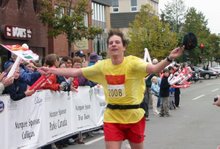
Alex with Ramesh Ferris
trying out Ramesh's hand cycle
(watch the video of Alex hand cycling)

Photos below by Chris Madden,
Community Liaison, Cycle to Walk

On Tuesday, September 16th, Alex and I were honoured to join Ramesh Ferris and, along with Cpl. Dave Cheverie, escort him through the streets of Charlottetown on his cross-Canada Cycle to Walk.

When I first heard about Ramesh's campaign, to "raise funds and awareness to forward the global eradication of polio, to educate about the continuing need for immunization against polio and to support the rehabilitation of polio survivors in poor countries." I felt obligated to lend our voices to his mission. As a parent in the autism community I know too well that the declining vaccination rates - 11% of Canadians are not vaccinated against Polio - have much to do with the much discreddited myth that 'vaccines cause autism', a myth perpetuated by some of the more vocal and anti-science parents in the autism community.

A recent headline in the New York Times read "Measles Cases Grow in Number, and Officials Blame Parents"

"More people had measles infections in the first seven months of this year than during any comparable period since 1996, and public health officials blamed growing numbers of parents who refuse to vaccinate their children.

Many of these parents say they believe vaccines cause autism, even though multiple studies have found no reputable evidence to support such a claim. In Britain, Switzerland, Israel and Italy, measles outbreaks have soared, sickening thousands and causing at least two deaths."

This "better dead than autistic" attitude is not only extremely offensive, it is anti scientific fear mongering that is putting our children and out society at risk.

Ramesh tells us "According to WHO calculations, the rate of immunization [against Polio] is presently low enough to put Canada at risk for at least localized outbreaks."

“As long as a single child remains infected with the poliovirus, children in all countries are at risk of contracting the disease. The poliovirus can easily be imported into a polio-free country and can spread rapidly amongst immunized populations. Between 2003 and 2005, 25 previously polio-free countries were reinfected due to importations.” - (WHO)

There are few children for who vaccines are contraindicated and those children, babies too young to be immunized and those for whom the vaccine does not work depend on herd immunity to keep them safe. Please, unless your Doctor advises against it, please immunize your children. It is absolutely NOT better to risk death by a disease that can be prevented by vaccine. Countless peer reviewed scientific studies have shown NO LINK between vaccines and autism. Your children deserve this high standard of scientific evidence. New age, pseudo scientific celebrities who depend on Google for their education should not be trusted with your children's lives.

"No single medical advance has had a greater impact on human health than vaccines. Before vaccines, Americans could expect that every year measles would infect four million children and kill 3,000; diphtheria would kill 15,000 people, mostly teenagers; rubella (German measles) would cause 20,000 babies to be born blind, deaf, or mentally retarded; pertussis would kill 8,000 children, most of whom were less than one year old; and polio would paralyze 15,000 children and kill 1,000."

Dr. Paul Offit MD, author of Autism's False Prophets: Bad Science, Risky Medicine, and the Search for a Cure

(Paul A. Offit, MD, is a pediatrician specializing in infectious disease medicine, an internationally known expert on vaccines, immunology, and virology, the Maurice R. Hilleman Professor of Vaccinology, Professor of Pediatrics at the University of Pennsylvania, Chief of the Division of Infectious Diseases, and the Director of the Vaccine Education Center at The Children's Hospital of Philadelphia. Offit has been a member of the Centers for Disease Control's (CDC) Advisory Committee on Immunization Practices. Offit has published more than 130 papers in medical and scientific journals in the areas of rotavirus-specific immune responses and vaccine safety and is the co-inventor of a rotavirus vaccine )


Smallpox -- a disease estimated to have killed 500 million people -- was eradicated from the face of the earth by vaccines. Polio stands to be the second disease eradicated from the planet.

The US$200 million funding agreement between Rotary and the Bill & Melinda Gates Foundation marks another milestone in Rotary’s 20-year legacy of polio eradication work.

Rotary, a volunteer service organization of 1.2 million men and women, made a commitment to immunize the world’s children against polio in 1985 and became a spearheading partner in the Global Polio Eradication Initiative three years later. The other partners are the World Health Organization, the U.S. Centers for Disease Control and Prevention, and UNICEF.

Rotary’s primary responsibilities include fundraising, advocacy, and volunteer recruitment. To date, Rotary has contributed nearly $700 million to the eradication effort, an amount that will grow to more than $850 million by the time the world is certified polio-free.

[...]

Thanks to Rotary and its partners, the number of polio cases has been slashed by more than 99 percent, preventing five million instances of childhood paralysis and 250,000 deaths. When Rotary began its eradication work, polio infected more than 350,000 children annually. In 2007, fewer than 2,000 cases were reported worldwide.

But the polio cases represented by that final 1 percent will be the most difficult and expensive to prevent for a variety of reasons, including geographical isolation, worker fatigue, armed conflict, and cultural barriers.

That’s why it’s so important to generate the funding needed to finish the job. To ease up now would be to invite a polio resurgence that would condemn millions of children to lifelong paralysis in the years ahead.

The bottom line is this: As long as polio threatens even one child anywhere in the world, all children – wherever they live – remain at risk.

--Source

We were proud to join Ramesh and support his campaign to eradicate Polio, educate Canadians on the importance of immunization and support the rehabilitation of Polio survivors in poor countries. Please take a moment to visit Ramesh's website www.cycletowalk.com and consider showing your support by donating to the Cycle to Walk and/or emailing him some words of encouragement.

Thank you to Ramesh, Chris and the rest of the Cycle to Walk crew. It was a pleasure to meet you all and spend a bit of time together. We wish you a safe & successful journey as you make your way to Newfoundland.

See all the photos Chris Madden & I took that day here.
You can hear Ramesh tell his story here on this YouTube video.
Watch Alex try out Ramesh's hand cycle here.


Below is Ramesh's blog post of Tuesday, September 16th:

Follow Ramesh's Journey

Day 158- Charlottetown, PEI- (Non-Official Route Cycling)
by Ramesh Ferris, posted in Road Updates - Tue, September 16, 2008

imageThe team hit the road at 6 am today to visit Rotarians in Sunnyside, PEI. The club’s president, Sandy Rundle, announced that the club has been so inspired by Cycle to Walk that they will make a significant contribution to Rotary International’s PolioPlus program in honour of Cycle to Walk in the near future. After some best wishes, donations and an interview with the local paper, we headed back to Charlottetown – but not without stopping to check out the Confederation Bridge first.

Back when we first arrived on the island, we were invited to visit MacQueen’s Bicycle Shop in Charlottetown to get the bike serviced. This morning we took it in for one last tune up, cable replacement, and brake alignment. I believe that now the hand cycle will handle the final 500 km of the Cycle to Walk cross-Canada tour with no problems.

Dr. Sean Wiebe of from the University of Prince Edward Island’s Global Issues class invited the team to speak with his students today. Just like yesterday’s class, students demonstrated lots of interest in the Cycle to Walk campaign and asked lots of questions. Thank-you to all of the staff and students at the UPEI for showing so much care and support for the team and the message of Cycle to Walk. Education about polio must continue both in and out of the classroom. We need to work together as a global community to eradicate polio once and for all.

11 per cent of Canada’s population has not received the polio vaccination. That means over 3.4 million Canadians are at risk of contracting the poliovirus. There are a number of reasons why Canadians are not receiving the polio vaccine, such as an ‘out of sight/out of mind’ attitude, miseducation that polio has already been eradicated, or myths that the polio vaccinations lead to side effects such as autism.

There is absolutely no scientific evidence that the polio vaccination is responsible for causing autism.

It’s important for parents to ensure that their children receive the three doses of the polio vaccine at two, four and six months of age. Even adults need to ensure that their immunizations are up to date – especially if travelling overseas. Anyone who has not received the three doses of the polio vaccine can be a carrier of the virus, putting others at risk of contracting polio.

This afternoon, I hand cycled through the streets of Charlottetown accompanied by a local PEI Hero by the name of Alex Bain. Alex is 20, and he lives with autism spectrum disorder. Both he and his mother Janet were so excited to join in support of the Cycle to Walk campaign and share the important message that people need to continue to receive the polio vaccine. Alex had absolutely no problems keeping up as he is known for his long distance marathon running. In 2006, Alex ran across Prince Edward Island – tip to tip – to raise awareness about autism and to celebrate ability. It’s reassuring and wonderful to know a person living with autism who is willing to put himself in the public and show support for the polio vaccine. Thank you so much, Alex, your support. It means a lot to me, and it was great to spend part of the afternoon with you. View Janet and Alex’s blog entry here.

Alex, Janet and Iwere kept nice and safe because of the great work of
Corporal Dave Cheverie of the Charlottetown Police. Thanks, Corporal Cheverie, for the lights, sirens, safety, and support.

We ended our day back on campus at the UPEI to speak at Campus Kids daycare. What a treat it was to be surrounded by such attentive, inquiring, smiling, and supportive young children. Thank you to Trish Daley, daycare staff, and all of the children. You truly brought a lot of joy into our day when you demonstrated so much interest to learn more about polio and the Cycle to Walk campaign.
It’s unbelievable, but our time is quickly coming to an end here in PEI. The team will catch the Wood Island ferry back to Nova Scotia tomorrow morning continue eastward on our journey. Thank you so much to our wonderful hosts, the Campbells and the Mathesons for hosting the team over the last couple of days!

imageimageimageimageimageimageimageimageimageimageimageimageimageimageimageimageimageimageimageimageimageimage


Polio still a problem: activist


STEPHEN BRUN
The Journal Pioneer


SUMMERSIDE – Ramesh Ferris is a study in contrasts as a survivor of polio.

As a six-month-old in India, the disease crippled his legs. But he is now nearing the end of a cross-Canada awareness campaign that demonstrates what proper rehabilitation can do for polio survivors.

Ferris is using a hand cycle to travel across Canada to raise awareness for the eradication of polio. He said Canadians have become complacent about vaccinations over time, while some even think the disease no longer exists.

“We’ve had a prevention for over 53 years, yet children continue to die and become paralyzed by the effects of polio,” said Ferris at a recent Summerside Rotary meeting.

“If we choose not to continue the fight against polio, an additional 10 million children will be paralyzed over the next 40 years and we risk losing the $4-billion global investment we’ve put into the eradication efforts.”

Ferris began his Cycle to Walk campaign on April 12 in Vancouver in honour of the date in 1955 when Jonas Salk’s polio vaccine was released.

To date, he has travelled 6,700 kilometres and will end his cycle at Cape Spear, Nfld., on Oct. 1. Ferris plans to eventually raise $1 million, 75 per cent of which will go to Rotary’s Polio Plus program, while 20 per cent will go to polio survivors in poor countries and five per cent will be spent on education about the disease.

“It’s a reminder that there’s still people dying from the effects of this horrible disease that we should’ve eradicated years ago,” he said.

“My drive and my passion toward doing that won’t stop in Newfoundland.”

In India, because his mother didn’t have access to the health care Ferris needed, an Anglican bishop in the Yukon adopted him as a two-year-old in 1982.

He was able to access the braces, crutches and surgeries he needed in Vancouver, and took his first steps with crutches a year later.

“It’s challenging, but I’m an example of what can happen if one doesn’t receive the vaccination, but what can happen if one has access to the proper rehabilitative care.”

Although great strides have been made against polio — it is only endemic in four countries around the world — new cases still crop up because people still don’t get the proper immunizations. This is something Ferris would like to change.

“As long as there’s a single case of polio, no country is polio-free.”

newsroom@journalpioneer.com

Wednesday, September 17, 2008

Hand-cyclist campaigns to eradicate polio

Hand-cyclist campaigns to eradicate polio

DOUG GALLANT
The Guardian
Ramesh Ferris is greeted by Lt.-Gov. Barbara Hagerman as he makes a stop at Fanningbank. Ferris is a polio survivor and is hand-cycling across the country to remind Canadians that the fight to end polio is not over. Polio is slated to become only the second disease eradicated in human history. Guardian photo

Ramesh Ferris was just six months old when he contracted polio in India.
Had he stayed in India, his future, without the use of his legs, would have been bleak.
But his mother, knowing she was not in a position to secure the kind of rehabilitative supports he needed for a healthy life, placed him in the care of a Canadian-founded orphanage, Families for Children, and put him up for adoption. She hoped he would find the care he needed with someone else.
Ron Ferris, the Anglican Bishop of the Yukon and his wife Jan adopted Ramesh and brought him to Canada. With the support of his new family, several surgeries and mobility aids he learned to walk with crutches for the first time at age four.
His experience with polio and the experience of seeing the impact polio still has on so many people in the country of his birth during a 2002 visit made him want to reach out and help.
In India he saw many polio survivors crawl on the ground because they were unable to stand or walk.
That experience ultimately led to Ferris undertaking Cycle To Walk, a campaign to raise money and awareness about the need to eradicate polio.
Since launching this campaign he has hand-cycled over 6,500 km.
Ferris is on P.E.I. where he continues to spread his polio eradication message.
Speaking Monday to the Charlottetown Rotary Club, Ferris made his case for a concerted worldwide effort to eliminate this disease. A Rotarian himself, Ferris spoke of the huge commitment Rotary International has made to eradicating polio but said there is still more to do.
“The fight to end polio isn’t over,” Ferris said. “Smallpox was eradicated in 1979, and polio could be next. We have all the tools we need to finish this job.”
He noted polio levels are down 99 per cent.
“But we need to give it one final push.”
And that push isn’t focused exclusively on India, Pakistan, Afghanistan and Nigeria, the four countries where polio is still endemic.
Canada is also part of the problem. Ferris is concerned about Canada because 11 per cent of Canadians are not vaccinated against polio.
He noted the disease returned to Australia in 2007 for the first time in decades.
There is no cure, but the disease can be prevented through vaccination and Ferris wants everyone to be vaccinated.
The fight to eradicate polio — led by Rotary International and the World Health Organization — is the largest public health initiative in world history but annual funding shortfalls are preventing complete success.
Through Cycle to Walk Ferris hopes to raise $1 million before reaching Cape Spear, N.L., this October.

On the Net: www.cycletowalk.com

Monday, September 15, 2008

"Alex.......and his family are encouraging families to vaccinate their children" - Supporting Ramesh Ferris' Cycle to Walk

Cycle to Walk Media Release

Tomorrow at 1 pm Ramesh Ferris' Cycle to Walk (www.cycletowalk.com) cross-Canada campaign will be escorted through the streets of Charlottetown by police.

Ramesh's legs were paralyzed by polio when he was an infant. He rides a hand cycle.

The ride will end at Joe Ghiz Park (corner of Grafton and Kent) at approximately 1:30.

Ramesh will be joined by local runner Alex Bain, who is an autistic long- distance runner. Alex supports the Cycle to Walk campaign, and he and his family are encouraging families to vaccinate their children.

There have been false claims that childhood vaccinations can lead to autism. Alex hopes to silence those claims through his support of Ramesh's campaign.

The route is as follows:

- Start at the north end of Queen Elizabeth Drive at Charlotte Street.
- Follow through to Park Roadway. It will become Kent Street.
- Follow Kent Street through town and end at Joe Ghiz Park (corner of
Grafton and Kent).

Since its beginning in Victoria BC on April 12, Cycle to Walk has raised nearly $300,000 to help eradicate polio worldwide, rehabilitate polio survivors, and educate Canadians about the ongoing need to get vaccinated.
Cycle to Walk will end at Cape Spear Newfoundland on October 1.

11 per cent of Canadians have not received the polio vaccination. There is no cure for polio, but safe prevention has existed since 1955.

Polio infected an Australian man in July 2007. It is history's greatest cause of disability.

Ramesh Ferris will be available for interview after the ride at Joe Ghiz Park.
Janet Norman-Bain, Alex's mother, will be available for interview also. Janet has Asperger's Syndrome, a form of autism, and she is the mother of an autistic child. Janet and Alex together wish to support the Cycle to Walk campaign and encourage parents to get their children vaccinated.
------
Please contact me if you'd like to set up an interview at another time, or if you'd like more information.

Chris Madden
Community Liaison

Cycle to Walk
867-334-8992
media@cycletowalk.com

Charlottetown Terry Fox Run 2008

Special Guests

Lt. Governor Barbara Hagerman, Health Minister Doug Currie, Charlottetown MP Shawn Murphy,

Charlottetown City Councilman Peter McClosky and Premier Robert Ghiz.

Janice Duffy speaks on her cancer battle.

At the warm up with Gord of UFIT

They started with walkers, roller bladers, bikers and runners.

The other Alex who wear a red shirt ran with me at front of the run.

Premier Robert Ghiz at the 2.5km water station.

My father as traffic volunteer.


My Nannie and Aunt came to watch and support.


BBQ after with hot dogs and drinks.

Run organizer Athena Doyle with Ewen Stewart.

Saturday, September 13, 2008

ADL Golden Mile - On the heels of an Olympian

(Photo: Kara Grant & Alex)
It was cloudy and 14 degrees.

The 25th ADL Golden Mile at North River Road.

Kara Grant ahead of me in 3rd position.

I finishes in 4th overall out of 52 runners.

Stephen Bagole won the race in under 5 minutes of 4:59 and Kara Grant for the top female.

I got a 3rd place male ribbon.

Tomorrow I run 10km for Terry Fox Run at Victoria Park.

More Photos (ours)


Official Result: 4th out of 52
1 mile in 5 minutes, 38 seconds

Golden Mile 2007
Golden Mile 2006
Golden Mile 2005
Golden Mile 2004

Running For Autism
Not Against It
acceptance not cure

Community to host reception for P.E.I. Olympian

Community to host reception for P.E.I. Olympian

The Guardian

Jared Connaughton, from New Haven, P.E.I., celebrates
as he crosses the finish line after winning the 200m final
at the Canadian Track and Field Trials in Windsor, Ont.
Sunday, July 6. Canadian Press photo


CORNWALL — The community of New Haven/Riverdale will host a reception for Jared Connaughton at the APM Centre in Cornwall on Sunday, Sept. 21, at 2 p.m.
All are welcome to attend the reception.
“We are extremely proud of Jared’s accomplishments over the past year, including his participation in the Olympics in Beijing,’’ said Sharon Slauenwhite, chair of the New Haven/Riverdale community council. “Although Jared has received recognition on the national and international stage, he has always remained loyal to his home community and province. It is time that we formally recognized Jared for his accomplishments.’’
Donalda Docherty, who is organizing the reception, praises Connaughton’s tenacity.
“Jared is a tenacious individual pursuing his dream with a focus on competing and winning at the highest level. He is an inspiration, not only to children in sports but to everyone with a desire to do their best,’’ said Docherty.
“We want to take this time to allow all Islanders and visitors to meet Jared and offer their congratulations for a job well done.’’
Connaughton is a graduate of Bluefield High School and attended the University of Texas at Arlington where he was named All Conference 13 times and a Division 1 Midwestern All American.
He is the 2008 Canadian national champion in the 200m and holds the Canadian trial and Windsor Stadium record of 20.34. Connaughton also has the fastest Canadian 100m in 2008 at 10.15.
He qualified through to semifinals in the 200m sprints in Beijing and also ran the third leg as a member of the Canadian 4 X 100m relay team which finished sixth at the Olympic final.
Connaughton is considered by experts to be one of the best corner runners in the world.
He plans to continue to race professionally with a goal of competing for a medal in the 2012 Olympics in London.
He is on the Island this month for some rest before rejoining the professional racing circuit.
Connaughton’s next major competition is the 2009 world championships in Germany.

Duffy draws strength from Terry Fox in her cancer battle

http://www.theguardian.pe.ca/index.cfm?sid=171050&sc=98
Duffy draws strength from Terry Fox in her cancer battle

BY JIM DAY
The Guardian


Janice Duffy, fighting cancer for the fourth time, knows she can lean heavily on the support of family members, like her sister Valerie Davies. Her husband, Bill, and several siblings will join Duffy in taking part in the Terry Fox Run Sunday. Guardian photo by Jim Day
Janice Duffy credits Terry Fox with helping her kick cancer — time and time again.
Three times the 49-year-old Stratford woman has fought back from the oft-deadly disease. Each time, chemotherapy seemed to do the trick.
Duffy feels Fox played a key role in her recoveries on two levels. First, his Marathon of Hope has raised more than $400 million worldwide for cancer research, resulting in the development of better treatment for Duffy and countless others.
Also, Fox set an example of a remarkable fighting spirit that Duffy also embraces in her own determined effort to beat cancer.
“You do what you have to do and you keep going,’’ she said.
“That’s what I learned from him. You never give up.’’
For years, Duffy has marvelled at Fox’s amazing feat of running 5,373 kilometres in 143 days before he was forced to stop on Sept. 1, 1980 because cancer had appeared in his lungs. He died 10 months later at age 22.
Yet his fierce, selfless quest to run across Canada to raise money for cancer research, while never fulfilled, still resonates with millions of people, Duffy most certainly among them.
“You’ve got to keep going,’’ said Duffy, who is once again in the throes of cancer.
“And that’s what Terry did. How many miles did he run with his lungs being full before he actually had to stop? I can tell you, he was probably in a lot of pain for a lot of days.’’
Duffy refuses to let cancer keep her down. With the disease currently attacking her right lung and while under the tiring strain of chemotherapy, she is still set to take part Sunday in the Terry Fox Run.
She may complete five kilometers or it might be three, two or even less. But she plans to be there and give it her all.
Duffy will be buoyed by her strong support system, consisting of husband Bill, a crowd of siblings, and friends. Her 16-year-old daughter Katie is trying to get time off work to also be by her side. If not, Duffy knows the teenager will be there in spirit.
Duffy gets choked up speaking of just how much it means to her to have such deep support from family, including that of her nine brothers and sisters, in a nearly decade-long on-again, off-again battle with cancer.
“There are high and low moments,’’ she said.
“I don’t have days, I have moments. And I have a great support system (to deal with the low moments).’’
For years, she has been involved in the Run for the Cure and the Relay For Life. She has been actively supporting these cancer research fundraising efforts to help raise awareness that research and development into this disease has been paying big dividends.
“Like I wouldn’t be here today, I don’t think, if all the people weren’t out there working hard to try and find a cure for cancer,’’ she said.
And Duffy became a Terry Team member this year for the same reason.
She believes she owes her life, perhaps several times over, to what appears to have been unstoppable momentum and significant ongoing financial support that Terry Fox’s legacy has channeled into cancer research and development.
“My feeling is his ultimate goal was to find a cure and that’s my ultimate goal is to help find a cure,’’ she said.
“So whatever I have to do to do that, that’s what I’m willing to do.’’

http://www.theguardian.pe.ca/index.cfm?sid=171051&sc=98
Lots of Terry Fox runs going Sunday across P.E.I.


By Jim Day
The Guardian
Islanders can take part in the Terry Fox Run Sunday from any one of more than 20 sites across P.E.I.
Sixty schools in the province are also participating in the annual run, now in its 28th year of raising millions of dollars for cancer research.
Provincial director Onne de Boer, who oversees the run in both P.E.I. and New Brunswick, urged everyone to contribute to the cause.
“Terry only asked of us to give a dollar (each),” he said.
Last year, about $440,000 was raised between New Brunswick and P.E.I.
The run in Charlottetown begins at 1:30 p.m. at Victoria Park with registration one hour earlier.
In Summerside, registration is at the Credit Union at 1:30 p.m. with the run going along the boardwalk at 2 p.m.
Other locations and times for runs across P.E.I. can be found online at www.terryfoxrun.org (click on Provincial Pages, then go to Run Site Listings).
Participants won’t have to run far to hand in their pledges. Banks in Canada will be accepting pledge sheets and funds raised for the Terry Fox Run at branches throughout Canada again this year.
Pledge sheets and funds raised may be turned in at any branch of the following banks from Sept. 15 to Oct. 11, 2008: BMO Financial Group, Canadian Western Bank, CIBC, HSBC Bank Canada, National Bank Financial Group, RBC, Scotiabank and TD Canada Trust.
After Oct. 11, funds and pledge sheets should be mailed to a provincial Terry Fox Foundation office.
The first Terry Fox Run in 1981 attracted 300,000 participants across Canada and raised $3.5 million. To date, more than $400 million has been raised worldwide for cancer research in Terry Fox’s name.
Last year, about 1,100 people participated in the runs on P.E.I.
While called the Terry Fox Run, participants are welcome to cover the different routes, depending on the surface, in any fashion they choose from rollerblading to leisurely stroll, added de Boer.

Friday, September 12, 2008

Terry Fox Run this Sunday


The annual Terry Fox Run goes this Sunday.

If you'd like to donate, consider sponsoring Alex.
Click HERE (or on the logo to the right) to get to his online sponsor page.


If you want to join him at the Charlottetown Run, here's what you need to know:

DATE: SUNDAY - SEPTEMBER 14 - 2008
DISTANCE:
5k & 10k run/walk/bike
REGISTRATION:
12:30pm -1:30pm @ Victoria Park field near the Dairy Bar. Registration is by Pledges. Last minute entries without a pledge sheet is asked to make a minimum donation of $10 to enter event.
OPENING CEREMONY:
1:30pm
START TIME FOR RUN/WALK/BIKE:
2pm sharp
COURSE DESCRIPTION:
5k loop around Victoria Park and residential area

Pledge Sheets are available now. Check at your grocery stores and various places intown.


If you can volunteer Athena wants to hear from you:

If you would like to volunteer and she does need lots of energetic volunteers! Could you email Athena at this address charlottetownpei_terryfoxrun@yahoo.ca and provide your name, phone number, and shirt size (sizes are limited), and also list any previous volunteer experience. She will then let you know when and where to meet and provide all other pertinent information you will need to know for the day of the event.

Thursday, September 11, 2008

Update on Appalachian Trail hiker Linus Gillis

Update on Appalachian Trail hiker Linus Gillis

The Journal Pioneer

The following photo and caption information was submitted by Monette Burnett:

"On Sept 2 /08 RON MURPHY & ALLAN MAC KENZIE Leaving To meet our hero LINUS GILLIS being on the Trail for 6 months now.
300 miles left to do. Destination Gorm New Hampshire On Thursday afternoon Ron went looking for Linus On a turn to the trail LINUS happend to see RON first and a big shout came off Linus :(EH are you lost?????) the 2 was so happy to see each other big embraces and one more was to be deliver for FAYE Linus s wife Linus doing super good.
Linus is doing good encounting his long hr of hiking and his body full of sores and bruises looking to be back soon to SUMMERSIDE back where he belong with friends and familly."

On The Run - P.E.I. Marathon around corner


On The Run
P.E.I. Marathon around corner

STAN CHAISSON
Guardian column


I can already smell it in the air, I can feel the chill on my early morning runs and soon we’ll see the beautiful colours of fall that remind us that our great Island Marathon is quickly approaching.
In all the excitement of training for the BMO Nesbitt Burns P.E.I. Marathon weekend, be careful, it’s easy to over do it in the last few weeks and injuries can occur, despite your best efforts to avoid them.
There are many methods to prevent and treat injuries so that your training can continue as scheduled.
If you feel discomfort in a muscle or joint don’t ignore it and assume it’ll go away. Many times I’ve said to myself ‘ah I’ll be fine, I can run through it.’
It’s usually a week or so later when I say, ‘what the heck was I thinking?’
In many instances “running through it” can make things worse and lead to frustration and, in my case, crankiness. Listen to your body, it’s telling you to ease up and take a break.
The first thing you can do to avoid injuries is to focus on your event and let other activities take a back seat.
Whether you’re training for the 10-kilometre walk or the marathon, you need to focus your attention and energy on this task.
Sometimes that means sacrificing other activities like contact sports, or high intensity workouts that may cause injuries or put extra stress on your body. You’ve come all this way in your training, focus and preparation for your event should be your highest priority.
Taking proper rest periods throughout your training is probably the best way to prevent injuries. There’s a time to work hard and a time to rest hard and they are equally important. Too much or too little of either of these can get you in trouble.
A tool I use within my training programs is taking a recovery week every month. Mileage decreases significantly and stretching, massage and proper hydration and nutrition are the main focus for the week.
Your taper, or the last few weeks of your training plan, is also of great significance because it’s the time your body adapts to the workload. Stretching and strengthening exercises throughout your plan will also decrease the risk of injury.
If it’s too late for this and you’re already suffering form a nagging injury don’t panic.
First thing first, put your training on hold for a few days to give your body rest.
Believe me, I know this isn’t fun, I know you’ll feel like you’re losing your fitness, I know you may be a little bit cranky, but in the end it’ll be the best decision you can make and it’ll get you up and running better than ever before.
Ice the area of the muscle or joint that is painful and take an Advil to limit inflammation.
You can wrap the injured area with a bandage to provide support or put your feet up and elevate the injured area to limit swelling.
If a few days doesn’t take care of the problem it’s time to seek treatment from a physiotherapist. Remember, be patient and stay focused.
Injuries can be annoying, frustrating and can force many runners to hang up their shoes and give up. Don’t let these aches and pains get the best of you.
Follow the proper precautions and you’ll be OK.
Don’t let these temporary delays make you miss an event and a feeling that’ll last forever.

Stan Chaisson is a certified kinesiologist, trainer, avid runner and exercise enthusiast. His weekly column will provide advice and training tips for those preparing for the BMO P.E.I.Marathon, Oct. 18-19. www.princeedwardislandmarathon.com

Wednesday, September 10, 2008

Distance runner John Paul considered one of the greatest

Distance runner John Paul considered one of the greatest
The Guardian

SUMMERSIDE — Long-distance runner William John Paul — originally from Half Way River, N.S., but an Island resident for over 50 years — will become a member of the P.E.I. Sports Hall of Fame on Sept. 20.
The annual inductions take place at the Silver Fox Curling and Yacht Club.
Paul will be joining two other great Mi’kmaq runners, Barney Francis and Michael Thomas, in the Island’s sporting shrine.
John Paul was a tough man, a hard, disciplined runner but with a majestic style that brought him countless titles in a career that spanned almost three decades and approximately 500 races.
Self-trained on the Island’s dirt roads, Paul’s finest hour probably came in 1936, when he finished an impressive 13th in the prestigious Boston Marathon.
Ten years later, after serving his country in the Second World War, Paul again competed in Boston and recorded yet another top-50 finish.
In the region, Paul was always a draw and spectators loved to see that smooth, elegant gait striding along, usually at the head of the field.
When John Paul raced, it was an event, and to go along with the countless titles, he shattered numerous regional records.
Interviewed some years after his last competitive race at the age of 50, John Paul attributed his success to having “the wind, and the will-power.”
The Saint John 10-mile trophy was his own personal property, winning it seven times, and other notable wins came in the Dartmouth six-mile race, the Cape Breton marathon and the prestigious Halifax Herald 10-miler, which he won twice, in 1940 and 1945, becoming the first Island winner since Michael Thomas in 1912.
Life was never easy for John Paul, both during his running days and in his retirement, but he left a legacy for all of those that were privileged to see him run.
One of his fans, Warren ‘Bun’ Hood remarked in Harold Gaudet’s Evening Patriot Town Talk column in 1976 that to see John Paul was “poetry in motion” and the “P.E.I. Sports Hall of Fame will never be right until the name William John Paul is enshrined therein.”
Tickets for the Hall of Fame inductions are now available for $10, available from either Sport P.E.I. at 368-4547, or the Silver Fox Curling and Yacht Club in Summerside.

Tuesday, September 9, 2008

On the Run - Nutrition and Hydration High Priority for Runners-


On the Run
Nutrition and Hydration High Priority for Runners

Stan Chaisson

Starting a walking or running program can be demanding on your body. Running for long distances burns huge amounts of calories, so you need to ensure you have the proper nutrients and fluids in your body before, during and after your workouts to increase your
chances of success. Time and time again runners make the wrong nutritional decisions and this can make for a very uncomfortable experience. Here are a few things to remember for your next training walk or run. Make sure you eat at least two hours before a workout or event. This will allow the food to digest properly and the energy will be absorbed and available for the exercise bout.

Also drink lots of water. A runner should never feel thirsty and should drink up to a liter of water before an event and up to two liters a day during training. Even though you maybe running to the washroom a little more often it’s very important to have your tank
topped up before you go out the door. Make a visit to a friend, make a pit stop at a gas station, or if there’s a nearby freshwater spring, why not? No matter what you do, having plenty of fluids will delay fatigue and improve performance.

On the other hand, if you don’t eat or eat too long before a run, your body will use up all
the nutrients from your last meal and even tap into your stored energy well before you
ever step foot on the racecourse. This can lead to premature fatigue and poor race
performance, also known as hitting the wall. I can’t suggest the perfect pre race meal
because everyone’s body is unique and may react differently to certain foods, but some
suggestions are peanut butter and toast, bananas, or oatmeal. The key is to try different
foods in your training runs and see what works for you.

Even though you may have fueled up before your run, you’re not in the clear. During
your run you still need to consider the risks of dehydration and energy depletion. If you
exercise more than an hour you should be consuming carbohydrates such as sports drinks,
sport gels or even candy periodically during your event. One to two servings of a drink
like Gatorade or PowerAde or 1-2 servings of sports gels per hour should do the trick.
You should also consider fluid needs. During hot and humid days, your body can lose
much needed water and can cause weight loss up to 2-4 pounds depending on how far
you run. This will not only decrease speed and efficiency, it can also lead to stomach
problems, muscle cramping and dizziness. An easy solution is to wear a water belt, plant
water bottles along your training route (make sure the top is on tight to avoid unwanted
visitors) and take advantage of all water stops during your event even if you don’t feel
thirsty.

After your event is finished you should pay close attention to recovery. In the excitement
of such a great accomplishment sometimes the celebration and busy atmosphere of the
finish line can distract you and it’s easy to forget to re-fuel your body. Endurance
exercise, much like strength exercise, causes small damages to your muscles. Therefore
after such exercise, it’s important to begin muscle repair immediately after the race. A
balance of carbohydrates and protein is recommended as soon as you finish up. Most
events like the BMO Nesbitt Burns PEI Marathon will provide post race snacks and
goodies to get you energized and ready to celebrate your victory.

Stan Chaisson is a registered kinesiologist, trainer, avid runner, and exercise enthusiast. His weekly column will provide advice and training tips for those preparing for the BMO Prince Edward Island Marathon, October 18-19 (www.princeedwardislandmarathon.com)

Monday, September 8, 2008

A Personal Best 15K and a 5K with an Olympian

On Saturday it was sunny and 19 degrees.

The Bank s Financial Group Run at Charlottetown area on the 5km loop.

I made the top 10 and under 20 minutes and came in 9th out of 56 runners and time of 19:29.

Stephen Baglole won the race and Kara Grant a two time Olympian who completes in Modern Pentathlon in Athens and Beijing for the top female.

Official Result: 9th out of 56
5K in 19 minutes, 29 seconds

Banks Financial Run 2007
Banks Financial Run 2006
Banks Financial Run 2005


Sunday it was cloudy and raining and 19 degrees.

The Rotary Run For Mikinduri at Stradford and Tea Hill.

The 15km course are hills and houses.

At 3km mark I saw Camp Gencheff, a summer camp when I young.

I made the top 10 and came in 5th out of 44 runners and time of 1:06:32 and a personal best by almost three minutes.

Tyler Sellar won the race and Pat Ellis for the top female.

In 5K Steven Reeves won the 5k race and Amy Boswall for top female.

More Photos (Rotary Run's)

Official Result: 5th out of 45
15K in 1 hour, 6 minutes and 32 seconds

Running For Autism
Not Against It
acceptance not cure


THANK YOU!

Thank you everyone for a great race!!

We can't tell you how grateful we are to see such a turnout this morning, both runners and volunteers, in what was definitely less-than-ideal weather. You all were just superb and your support is what made the first Rotary Run for Mikinduri possible. Preliminary figures show that we raised over $2,000 for the Children of Mikinduri and that's just the mark we'll have to beat next year. Of course, we will try to secure some better weather ...

We hope you all had a fun time today. We'll post times and pictures to the website in the next week, so stay tuned for that. In the meantime, stay dry, don't stand under anything metal while it's lightning out .. and keep running.

Thank you again!

Rotary Run for Mikinduri Organizers

Friday, September 5, 2008

Thinking big on a small stage - P.E.I. goalball athletes Contessa Scott and Amy Kneebone are in Beijing to compete


Thinking big on a small stage
P.E.I. goalball athletes Contessa Scott and Amy Kneebone are in Beijing to compete


CHARLES REID
The Guardian

Contessa Scott, left, and Amy Kneebone run through
practices to keep themselves sharp for the
2008 Paralympic Games in Beijing. (Guardian photo)

It didn’t seem too difficult a question, just an icebreaker to get the interview rolling.

To Amy Kneebone, it’s more. She hesitates at ‘what has she learned from Contessa Scott, her teammate on Canada’s women’s goalball team, about what to expect at the 2008 Paralympic Games in Beijing, China?’

“Hmmm,” answered the 18-year-old Kneebone.

The sound echoes in the quiet gym at Park Royal church where Scott, a two-time Paralympic gold medallist, and Kneebone, a Team Canada Paralympic rookie, practised twice-weekly before leaving for Beijing.

“I know. I’m not that special,” said Scott, 34, laughing.

Scott is a vision-impaired farmer from Clyde River with a dry but rollicking sense of humour.

She is also one of P.E.I.’s most successful athletes at the national and international level, in any sport.

She has back-to-back Paralympic gold medals around her neck and world and national goalball titles in her showcases.

But after a few seconds, Kneebone, a member of Canada’s 2006 world championship team, finds an answer.

“Pretty much go into every game having it in your head the team is going to get scored on. I’m not going to be the one to let up. You know, have that kind of confidence going into it all,” said Kneebone, who admits to a bit of nervousness.

Who wouldn’t be?

Beijing in 2008 is the athletic big time. It’s two weeks of sights, sounds and smells unlike any other.

The Olympics had its 15 minutes of fame, now it’s time for the Paralympics to come out in its Sept. 6-17 debutante ball.

But that’s the off-court stuff.

On the 18-metre long by nine-metre wide goalball floor, it’s a narrower focus.

The trick, says Kneebone, is thinking small.

“When it comes down to it you’re just going to be in a gym and the markings, the whole court size is all going to be the same,” she said. “By the time you get into a game . . . you’re dealing with the exact same amount of space you always have.”

Canada is the two-time defending Paralympic champion and the seven other countries in the week-long goalball tourney will be gunning for the Canucks.

Scott’s team is also defending world champ, courtesy of a 5-2 victory over China at the 2006 championship in North Carolina.

The win qualified Canada, which also includes Saskatchewan’s Amy Alsop and Shawna Ryan, Ontario’s Annette Lisabeth, and Quebec’s Nancy Morin, for Beijing.

It’s no cakewalk to the podium, however, in a round- robin tourney where team plays each other once and top four reach the semifinals. Kneebone and Scott admit Canada’s competition has beefed-up in the last two ears and say up to six teams have a shot at the medals.

And Canada has been less than dominant.

Recent tournaments in Sweden, where it didn’t reach the semifinals, and Alabama, where it lost in the final to Denmark, prove it.

Scott says the stronger field is a matter of mechanics, innovation and imitation.

“Different throws that are being used now and teams are starting the follow the example that we had set in the two Paralympics by being in good physical condition,” says Scott. “What’s coming in the last year or two is the bounce shot. The ball is bouncing say four times before it gets to the other end.”

That move to complement straight hard shots and curves is perfectly legal as long as it hits once on throwers side, once in the middle and once on the defenders side.

The Japanese brought in the trick which uses the ball’s proclivity to bounce off a defender and into the net.

It’s caught on, too, as Sweden, America, China, Brazil and Canada’s Lisebeth utilize the strategy. In Brazil’s case, with gusto.

“There’s actually a girl from Brazil that will throw backwards between her legs,” said Kneebone. “It looks ridiculous, but it’ll bounce the whole way.”

“I think two or three of them play in bare feet,” says Scott, wearing burly protective gear that has her looking like a linebacker.

Still, ask the pair if the world has caught up and there is more hesitation.

“You don’t like to say no,” said Scott.

“And you don’t like to say yes,” Kneebone followed.

“When we’re playing at the top of our game, we are the best at what we do,” said Scott.

Although the team is spread throughout the country, internet and old-fashioned phones keep members in touch. That and week-long practices once a month in Montreal keep the team connected, says Scott.

Since 1984 in New York, the first year of women’s goalball, Canada has won two gold, two bronze and a silver. Scott, now a goalballer for over two decades, has been a part of the best years.

But is the veteran nervous?

“Sure, I’ve got two gold medals going over there to defend. There hasn’t been a team that’s won Worlds and won Paralympics. Any team that’s won a world championship has never won a Paralympics. There go our odds,” she says. “Hey, there’s always a first for everything and it could be us.”

Canada is coached by Janice Dawson, who took over the national team from Stratford’s Frank MacIntyre in 2006.

The P.E.I. Department of Communities, Cultural Affairs and Labour has set up a website — www.gov.pe.ca/olympics —?where Islanders can post messages to Kneebone and Scott.

Team Canada is comprised of 280 athletes, coaches, team leaders and mission staff.

*****

Canada’s Paralympic goalball schedule (all times AT):

Sunday - vs. Sweden, 12 p.m.

Monday - vs Brazil, 7 a.m.

Tuesday - vs. Japan, 12 a.m.

Wednesday - vs. Germany, 12 a.m.

Thursday - vs. Denmark, 10 a.m.

Sept. 12 - vs. United States, 2 a.m.

Sept. 13 - vs. China, 1 a.m.

Sept. 14 - Semifinals begin.

*****

A Beijing Paralympics primer:

What is it? - An international, quadrennial, multi-sport event for athletes with physical, mental and/or sensorial disabilities, including mobility and visual disabilities, amputees and those with cerebral palsy.

When is it? - Sept. 6-17, 2008, three weeks after the closing of the 2008 Olympic Games.

Where is it? - Beijing, China.

Sports - 20, including goalball, sailing, rowing (new for 2008) and wheelchair rugby.

Started - 1960 in Rome, Italy. Officially called the ninth annual International Stoke Mandeville Games, it’s considered the initial Paralympics. The first winter Paralympics were in Sweden in 1976.

*****

A quick lowdown on goalball:

* Goalball is a team sport for men and women who are blind or partially sighted. A team has six players but only three players per team can be on the court at any one time.

* All competitors wear blackout masks to ensure that none have any light perception or vision.

* The object is to score goals by rolling a goalball using a bowling action toward the opposing team’s goal, which spans the entire width of the court.

* Players attempt to prevent the goalball from crossing the goal line. Goalballs contain noise bells along with raised lines on the court to help orient the players.

Wednesday, September 3, 2008

Island athletes head to Beijing for Paralympic Games


Island athletes head to Beijing for Paralympic Games
STAFF
The Journal Pioneer


Island goalball athletes Contessa Scott and Amy Kneebone are heading to Beijing.

They are competing in the 13th Paralympic Summer Games in Sept. 6-17.

This is the third trip to the Paralympic Games as a member of Team Canada for Contessa Scott of Clyde River.

She earned gold medals in Sydney, Australia (2000) and Athens, Greece (2004). In 2004, Contessa was honoured with the Lt. Governor's Award, and she was named both Outstanding Athlete of the Year and Senior Female Athlete of the Year by Sport P.E.I.

Amy Kneebone of Charlottetown is making her first appearance with Team Canada at the Paralympics. She has been competing in goalball for five years and was a member of the first place Canadian team at the 2006 World Championship.

This past July, Amy scored two game-winning goals in round robin play over Japan and Denmark in the Lakeshore Foundation International Goalball Classic in Birmingham, Alabama.

“Amy and Contessa are exceptional athletes and wonderful role models for young Islanders throughout our province,” said Minister Carolyn Bertram, P.E.I.'s minister responsible for sport.

“I wish them continued success at the Paralympic Games in Beijing as they reach for gold and live out their lifelong dreams.”

The Department of Communities, Cultural Affairs and Labour has set up a website, www.gov.pe.ca/olympics, where Islanders can go online and post messages of encouragement to Amy and Contessa.

The Minister added, “I encourage Islanders to log onto our new website and let Contessa and Amy know that we are cheering for them!”

Contessa Scott and Amy Kneebone are two of about 150 Team Canada athletes, who will be joined by 130 team officials (coaches, team leaders and mission staff), to make up one of Canada’s largest Paralympic teams.

BACKGROUNDER:

Goalball is a fast-paced sport played by athletes who have a visual impairment or who are blind. Played three on three, on a volley-ball size court, players track the ball by sound as they defend blistering shots upwards of 80 kilometers per hour.

The Paralympic Games recognize sporting achievement and skill for athletes with disabilities including amputees and people who are visually impaired, athletes with cerebral palsy, spinal cord injuries, and others.

On the Run - Consistency key to success

On the Run
Consistency key to success


Stan Chaisson

Whether you’re running your first event of you’re a seasoned veteran, training or walking
on a consistent basis is the key to success. When running becomes a habit it not only
becomes part of your day, it feels easier, you experience less fatigue, and the unpleasant
feelings that may have frequented you in the past are now few and far between. It’s very
simple, the more consistently you run the more enjoyable and rewarding it becomes.
Having this hobby built into your schedule will lead to many other benefits. Your
confidence will go through the roof as you realize that the hard work is all paying off.
You’ll start seeing major improvements in your performance and your motivation will
continue to grow. You’re mood will improve drastically, you’ll get more sleep and
increasing energy levels will improve productivity and allow you to tackle other activities
that may not have been possible before.

Improvements in health will also arise. Regular aerobic exercise will lower high blood
pressure, reduce stress and improve body composition. Running is a chance to unwind,
reflect on your day and clear your head. It is often a great time to think about the things
that are important to you and to focus on the positive moments of your day and forget the
negative. With all of these physical and mental benefits I often ask the question why not
run?

So how do you stick with your program? I would suggest finding a running partner or
group and meet new people that enjoy the same hobbies to help you stay motivated. To
make sure you do a workout, there's nothing like the social support of knowing someone
else is waiting for you. It's a change from running by yourself and it’s a great boost
especially if you're doing a long run or a speed workout on the track. Most importantly
It’ll keep you accountable and on a manageable training schedule. So gather up the coworkers
or family members set a running night and get moving. It’ll be a fun challenge!

Another great way to stay consistent is by keeping a training log. After each run, take a
minute to jot down a few notes about how it went. You can write how far you ran, how
long it took you, how the weather was, how you felt, what your pre run meal was and so
on. Having this reminder is motivating because you can look back and see all the work
you’ve done and all the improvements you’ve made. It’s also a great tool to find out what
works best for you. It reveals the secrets of your training and racing successes, and
provides lots of inspirational quotes and useful tips. Use this motivation to fuel your
training.

It’s just a matter of making time for yourself and planning walking and running into your
day and making it a priority. Without a plan it’s very easy to skip a run, and there’s
always excuses that get in the way. My suggestion is make excuses to run. Step up to the
challenge and reap the benefits of living a healthy lifestyle.

Stan Chaisson is a registered kinesiologist, trainer, avid runner, and exercise enthusiast. His weekly column will provide advice and training tips for those preparing for the BMO Prince Edward Island Marathon, October 18-19 (www.princeedwardislandmarathon.com)

Grant’s Olympic experience has highs and lows


Grant’s Olympic experience has highs and lows
Preparations did not result in planned personal-best performance in Beijing
for modern pentathlete from P.E.I.


CHARLES REID
The Guardian


Being an international-level athlete often means soaring highs and bottomless lows.

An international stage like the 2008 Olympic Summer Games in Beijing, China, magnifies those chart points.

For modern pentathlete Kara Grant, her second Olympic Games became a mark on her career she wishes were erasable.

“Was I disappointed in my 31st-place finish? Yes. Perhaps more so since I did a great job with my preparation and was confident in a great performance in Beijing,” Grant wrote in a recent e-mail to The Guardian. “I did a lot of reflection in the months leading up to the Olympics and I was ready. For whatever reason this did not translate into the lifetime-best performance I was planning on giving.”

Grant returned to Canada last Friday.

The Stratford native finished 22nd at the Olympics in Athens, Greece, in 2004. That experience and good results in world competition in 2008 (a top-10 finish at the world championships and Canada’s first ever World Cup medal) had her primed to improve in China.

And in front of 20,000 spectators at the shooting venue, she placed 16th and, she said, felt prepared and determined for the fencing competition.

But after winning three straight matches to open the event, Grant said things soured as she drifted from her strategy and finished 24th with a 15-20 win-loss record.

“Unfortunately my eagerness to make touches and win bouts made me a little overeager at times and I had trouble sticking to my game plan. I made a number of unnecessary errors which amounted to giving away matches,” she said. “Considering the great training and results I had in fencing this year, it was perhaps the biggest disappointment of the day.”

Next for Grant, a confessed poor swimmer in modern pentathlon terms, the 200-metre freestyle swim loomed and while accepting she’d have the slowest time, she thought a personal best might be floating in the Yingdong Natatorium pool.

“I did not even come close,” said Grant, who finished dead last in 36th place.

By the riding event, Grant’s medal hopes fizzled. But she pressed on, hoping to rise in the standings before the final test in the 3,000-metre run.

There was a chance, too, as the riding match in men’s pentathlon the previous day produced wild changes in the rankings, some athletes moving up 15 places.

But again, that break didn’t come about. Officials removed difficult-to-control horses which evened out the field and meant massive changes weren’t likely.

That and trouble reining in her horse spoiled Grant’s hopes of leaping-frogging competitors.

“While a keen jumper, my steed had an inclination for speed and a disregard for the top rail of the jumps. He was too strong for me and I wasn’t able to control his speed well enough to leave the rails up,” said Grant. “While my five rails were an improvement over his other rounds (eight and nine rails respectively), the damage was done. I was well and truly at the bottom of the field this day.”

Grant finished a respectable 16th in the run, which she called “anti-climactic”, and edged up one place to 31st.

Winning modern pentathlon is about consistency because the margins of victory are thin.

Germany’s Lena Schoneborn, the gold medallist, finished 10th or better in four event of five events and earned 5,792 points.

Great Britain’s silver medal-winner, Heather Fell, totalled just 40 points less and Ukrainian Victoria Tereshuk took bronze, a mere 80 points from silver.

Grant ended the day-long competition 696 points away from the podium.

After the event, Grant, 29, spent a week touring Beijing with her husband Jamie Whynacht and her family while gaining a little perspective.

“I’m pleased to say that my result in Beijing has not affected how I feel about my choice to be involved in pentathlon, nor how I feel about the many excellent results I have had over the course of my 12-year career. Representing Prince Edward Island and Canada at two Olympic Games and numerous international competitions has been the experience of a lifetime,” said Grant.

“Thanks to everyone who has made this incredible journey not only possible, but extremely rewarding.”

Monica Pinette, who finished 27th, was the top Canadian.

Tuesday, September 2, 2008

Rotary Run for Mikinduri Race Maps

Rotary Run for Mikinduri

This coming Sunday, September 7th.

5Km & 15Km race maps:


Sign Up For 2009 Boston Marathon Begins Wednesday


Sign Up For 2009 Boston Marathon Begins Wednesday

BOSTON (WBZ) ― It's the time many runners have been waiting for. Online registration for the 113th Boston Marathon begins on Wednesday at 9 a.m.
The Boston Athletic Association has set a maximum field size of 25,000 runners for next year's race, which will be held on April, 20, 2009. Entries will be accepted until the limit is reached.

Applicants must meet certain time standards for their age group on or after September 29, 2007 to qualify for a marathon number. You can find the qualifying standards on the B.A.A. Web site.

The 2009 Boston Marathon will have a two-wave start again. The first wave of runners will start at 10 a.m. and the second wave will start 30 minutes later. Wave one runners had a qualifying time faster than 3:35 in last year's race.

Runners can also get numbers through several charities. In 2008, more than 1,200 runners represented the Charity Program's 24 organizations, combining to raise more than $11 million, according to the B.A.A.

http://wbztv.com/bostonmarathon/boston.half.marathon.2.771521.html

Boston Half-Marathon Registration About To Begin

BOSTON (WBZ) ― Registration for the eighth annual Boston Half-Marathon will begin this week.

Runners can begin signing up Wednesday July 16 at 9:00 a.m. by going to www.baa.org

You can register online or download a PDF of the application.

The registration fee is $54 and the field will be limited to just 5,000 runners.

This year's race will be held at 8 a.m. Sunday, October 12, which is Columbus Day weekend.

It will follow the same course through the Emerald Necklace parks and begin and end at Roberto Clemente Field.

There is a $30,000 prize purse for professional runners.