Showing posts with label Alex Bain. Show all posts
Showing posts with label Alex Bain. Show all posts
Tuesday, March 15, 2011
Alex at Work - Grinding Oats
Here's Alex with one of his newest machines at work, the industrial grinder. The Great Canadian Soap Company uses oatmeal in a number of its soaps as it provides the right combination of exfoliation, cleansing, moisturizing, soothing and protection for the skin (Corey can tell you all about it here in this video). Alex is the guy who grinds up all the oats.


Wednesday, February 23, 2011
Winter Weather Running - Wind Warnings & Whiteouts
This is what Alex's run home looked like the last two days. We've had winds gusting from 40-70Km/hr causing whiteouts and giving us wind warnings:
"This is a warning that an extended period of blowing snow with poor visibilities is expected or occurring in these regions"I took these pictures this morning around 9am, it didn't get any better by the time he ran home at 1pm.
Here's where his run home starts with the first (and worst) whiteout in sight:

The approach to that first whiteout:

Almost home:

The Crooked Creek in sight, less than 1Km to go:

Home to the shelter of the yard:

Looking at the Forecast
- Friday: Periods of snow. Low minus 7. High plus 2.
-
- Saturday: Periods of snow. Windy. Low zero. High zero.
-
- Sunday: A mix of sun and cloud. Low minus 14. High minus 9.
In 2005 we were getting snow and high winds and it took 45 minutes to get less than 4km from home, having driven through countless snowdrifts and under a downed power line. We realized even if we made it to Montague, a one hour trip on a good day, we'd never make it by race time. We turned around and came home (Alex was not impressed!) but 15 Half-Marathoners and 28 10K'ers braved the elements, got to Montague and ran the race (and by the looks of things likely froze their gizzards in the process!).
The weather on race day 2005:
 Last year 62 runners did the Half-Marathoner and 42 ran the 10K. "It was cloudy and 1 degrees and windy"
Thursday, February 3, 2011
Kong Hei Fat Choi
 by ~zowyx
"People born in the year of the rabbit are the luckiest among "the twelve animals." The rabbit is a symbol for mercy, elegance, amiability and worship of beauty. People born in this year are kind, speak gently, peaceful, quiet and loving persons. They like to live easy lives. They are reserved persons, love arts and have a strong sense of justice. Whatever they do, they will start well and end well..."
http://www.chinavoc.com/zodiac/rabbit/person.asp
Alex was born in the Year of the (Fire) Rabbit, 1987.
Wednesday, January 5, 2011
My Running Highlights of 2010
My Running Highlights of 2010
Top 5 running highlights of 2010
#5.
Leg 15 at Cabot Trail Relay
Leg 15 at Cabot Trail Relay
 Cabot Trail Relay Race
Related Posts
#4.
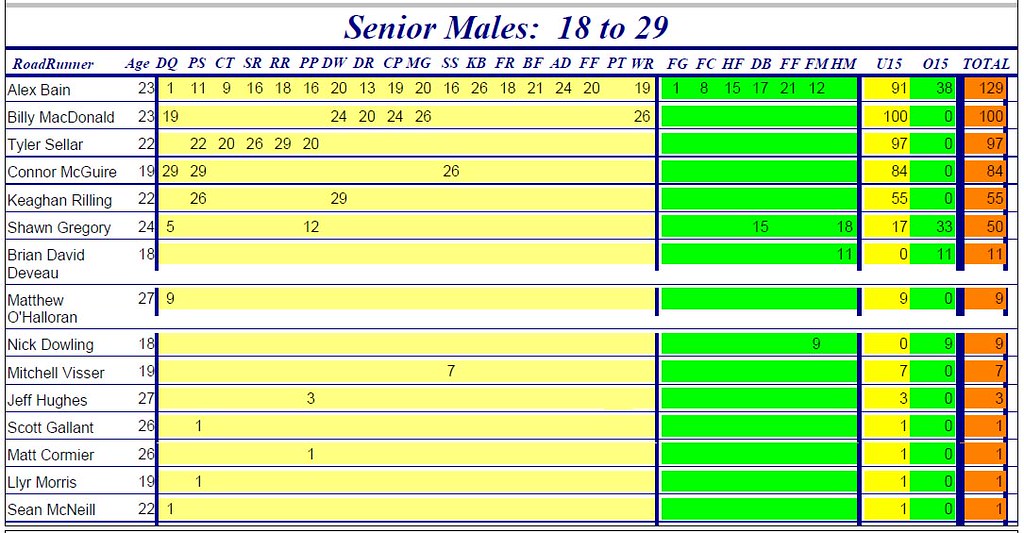
2010 18-29 Male Championship Points
 PEI RoadRunners Championship Points Totals
2010 Males Points Totals ~ 2010 Female Points Totals2010 18-29 Male Championship Points
 PEI RoadRunners Championship Points Totals
#3.
Sub 2 hours barrier at Harvest Festival 25km Run
Sub 2 hours barrier at Harvest Festival 25km Run
 Kensington Harvest Festival 25K
Related Posts
#2.
The Great Canadian Goat Run
The Great Canadian Goat Run


Wednesday, December 15, 2010
My Birthday

I went swimming after work.

I playing my new Wii game.
My new book One Hundred Greatest Canadian Sports Moments.


My Death by Chocolate birthday cake.

Thank you for all the Happy Birthday Wishes!

I having a Happy 23rd Birthday.
Thursday, December 17, 2009
My 22nd Birthday

I turned 22 on Tuesday. Dianne and Elaine get me a cake at the Roadrunner Party. They give me a gift card from Source For Sports and Rose give me a year of Canadian Running magazine.
On the birthday I got a Wii game, new shoes, Olympic mug and $250.
Tuesday night I went Wendys for supper, running group and bowling and then Death By Chocolate cake.
Thank You for the gifts and all the "happy birthday" on Facebook and the TDISC blog.
I had a very good year!
On the birthday I got a Wii game, new shoes, Olympic mug and $250.
Tuesday night I went Wendys for supper, running group and bowling and then Death By Chocolate cake.
Thank You for the gifts and all the "happy birthday" on Facebook and the TDISC blog.
I had a very good year!
Tuesday, October 6, 2009
The Other Alex Bain - 10 Favourite Quotes from "Born to Run"
"The other Alex Bain", formerly of Massachusetts, now of California, (we've written about him before here, here & here) just posted his 10 favourite quotes from Born to Run. Looks like a book some of those Brookvale Ultramarathoners would quite enjoy. This post is published on Alex's blog here:
http://maximumalexbain.com/post/205679738/heres-a-fun-new-thing-im-gonna-try-the-kindleWe follow not only Alex Bain's blog but also Furio Bain's blog. If you're a Facebook friend of (PEI's) Alex, you may have noticed he's a Fan of Furio Bain, the "cute, but complicated cat" who appears to be head of that Bain household.
I'm hoping Alex will forgive us for re-publishing it in it's entirety here.....

Here’s a fun new thing I’m gonna try: The Kindle allows you to do “virtual highlights” while you read, and it assembles the text you’ve highlighted on a web site. I went through my highlights from my last book, Born to Run, and here are my 10 favorite quotes. I’ll try to post one of these every time I finish a book, from now on.
Born to Run
- I’d learn that iskiate is otherwise known as chia fresca—“chilly chia.” It’s brewed up by dissolving chia seeds in water with a little sugar and a squirt of lime. In terms of nutritional content, a tablespoon of chia is like a smoothie made from salmon, spinach, and human growth hormone. As tiny as those seeds are, they’re superpacked with omega-3S, omega-6S, protein, calcium, iron, zinc, fiber, and antioxidants. If you had to pick just one desert-island food, you couldn’t do much better than chia, at least if you were interested in building muscle, lowering cholesterol, and reducing your risk of heart disease; after a few months on the chia diet, you could probably swim home.
- Coyote Fourplay, a semi-secret, invitation-only free-for-all described as “a four-day orgy of idiocy involving severed coyote heads, poisoned snacks, panties in trees, and one hundred twenty miles of trails you’ll wish you’d missed.” Fourplay is held at the end of February every year in the backwoods of Oxnard, California, and it exists to give a small band of ultrarunners a chance to whip each other’s butts and then glue said butts to toilet seats. Every day, the Fourplayers race anywhere from thirty to fifty miles on trails marked by mummified coyote skulls and women’s underwear. Every night, they face off with bowling tournaments and talent shows and endless guerrilla pranks, like replacing ProBars with frozen cat food and gluing the wrappers back shut.
- Eric and I eased back to a walk, obeying the ultrarunner’s creed: “If you can’t see the top, walk.”
- Wilt Chamberlain, all seven feet one inch and 275 pounds of him, had no problem running a 50- mile ultra when he was sixty years old after his knees had survived a lifetime of basketball.
- It was a mystifying gap in sports literature; distance running is the world’s No. I participation sport, but almost nothing had been written about its No. I practitioners.
- “I just don’t think I’m built for running fifty miles,” I said. “Everyone is built for running,” he said. “Every time I up my miles, I break down.” “You won’t this time.” “Should I get the orthotics?” “Forget the orthotics.” I was dubious, but Eric’s absolute confidence was winning me over. “I should probably cut weight first to make it easier on my legs.” “Your diet will change all by itself. Wait and see.” “How about yoga? That’ll help, yeah?” “Forget yoga. Every runner I know who does yoga gets hurt.” This was sounding better all the time.
- “Kenyans have superquick foot turnover,” Ken said. “Quick, light leg contractions are more economical than big, forceful ones.” “I don’t get it,” Alan said. “Don’t I want a longer stride, not a shorter one?” “Let me ask you this,” Ken replied. “You ever see one of those barefoot guys in a 10K race?” “Yeah. It’s like they’re running on hot coals.” “You ever beat one of those barefoot guys?” Alan reflected. “Good point.”
- If you had to choose between Neanderthals and Early Us in a Last Man Standing contest, you’d go Neanderthal all the way. So—where are they? Within ten thousand years of the arrival of Homo sapiens in Europe, the Neanderthals vanished. How it happened, no one knows. The only explanation is that some mysterious X Factor gave us—the weaker, dumber, skinnier creatures—a life-or-death edge over the Ice Age All-Stars. It wasn’t strength. It wasn’t weapons. It wasn’t intelligence. Could it have been running ability?
- Our diet shifted over the centuries from chewy stuff like raw roots and wild game and gave way to mushy cooked staples like spaghetti and ground beef, our faces began to shrink. Ben Franklin’s face was chunkier than yours; Caesar’s was bigger than his.
- To run an antelope to death, Lieberman determined, all you have to do is scare it into a gallop on a hot day. “If you keep just close enough for it to see you, it will keep sprinting away. After about ten or fifteen kilometers’ worth of running, it will go into hyperthermia and collapse.” Translation: if you can run six miles on a summer day then you, my friend, are a lethal weapon in the animal kingdom. We can dump heat on the run, but animals can’t pant while they gallop.
Friday, June 5, 2009

Friday, January 23, 2009
Athletes with Autism Spectrum Disorders - over at suite101.com
Alex is among those spotlighted in "Athletes with Autism Spectrum Disorders - Sports Achievements of Those with Autism and Asperger's Syndrome" by Jennifer Copley, over at suite101.com . Check it out HERE.

Thursday, January 15, 2009
Congratulations from the Autism Society of PEI
January 15th, 2009
Dear Alex
I am writing you today to offer you congratulations on behalf of the Autism Society of Prince Edward Island on your recent honour of being recognized as one of Canada's most inspiring runners by iRun magazine.
To receive such a recognition from a national publication speaks well to your success as a runner and in promoting greater awareness and understanding of Autism on Prince Edward Island. Your success is a shining example to all that individuals living with Autism can and do achieve great goals.
The struggle to promote greater acceptance and understanding of individuals living with Autism is not unlike a marathon run. It can be a long and winding road; it can physically, mentally and emotionally draining; and it requires focus and determination to succeed.
Your accomplishments are a shining example to all Islanders of the limitless potential that Islanders living with Autism possess. Again, congratulations on behalf of the Autism Society of Prince Edward Island on your most deserving award.
Sincerely,
Michelle Pineau,
President,
Autism Society of Prince Edward Island
Thursday, December 25, 2008


Wednesday, December 17, 2008
One Step Ahead - P.E.I. runner refuses to let autism keep him from competing

P.E.I. runner
refuses to let autism keep him from competing
 CHARLES REID
The Guardian
 Don’t pity Alex Bain because he can barely tie the laces of his running shoes.
In fact, don’t pity the 20-year-old Bain at all. He doesn’t feel any for himself; he’s too busy running marathons — 5Ks, 10Ks, 42Ks, anything to stay one step ahead of the autism which has dogged him for 17 years.
Autism is a brain development disorder characterized by impaired social interaction and communication, and restricted and repetitive behaviour, all starting before a child is three years old. One of its effects on Bain is limiting certain fine motor skills, such as tying shoelaces. Just last year he stopped asking his mother, Janet Norman-Bain, to tether them.
But autism was far behind in his 45th-place finish at the P.E.I. Marathon is October. The Oyster Bed Bridge native completed his first full marathon in 3:29:29.
And iRun Magazine, an Ottawa-based Canadian running periodical, noticed. It included Bain in its inaugural 12-person list of the most inspiring runners in the country. Called the 2009 iRun Awards, the roll is featured in the magazine’s January issue.
There isn’t a flashy award ceremony or inscribed trophy or engraved mahogany plaque, just a copy of the magazine. But for Bain, it’s not about rewards, it’s about acceptance.
“It makes me happy and proud. The people saw I am a good runner and did a good thing. I hope this award will help me get to be an Olympic torchbearer and more people will learn about me,” said Bain in an e-mail interview. “People will read the magazine and see me on (television) and in the newspaper and learn that people with autism can do lot of things.”
iRun also noticed his tip-to-tip run of P.E.I. in July 2006 to raise money for autism awareness and risk and safety management. Bain, with his mother (who played support crew, videographer and shoelace binder) in tow, ran up to 25 kilometres per day.
The $6,000 raised paid for seminars by an expert (Dennis Debbaudt) who trains law enforcement and first responders in recognizing and responding to autism in emergency situations, bought training videos for every police and RCMP detachment in P.E.I. and placed a card explaining how to recognize autism in the wallets of Island law enforcement officers, first responders and school-age autistics.
On the pavement, Bain has won other awards like the P.E.I. RoadRunners rookie of the year, junior RoadRunner of the year and inspirational runner of the year.
It’s further proof the condition isn’t a barrier for the 2005 Bluefield High School grad. And it just might be a bridge over the chasm of challenges autism presents, a span he began navigating in elementary school.
“I wanted to be on the cross-country team in Grade 4,” said Bain of why he started running. “There are a few people I heard of that run. (Saint John’s) Chris Brake holds (the second-fastest) course record in the Fredericton, N.B., marathon (2:41:40 in 2005). At least two autistics were in the New York Marathon this year. Not so many on sports teams, (but) I don’t think there are physical limitations.”
Just pesky shoelaces, which occasionally come untied such as in a five-kilometre race in Charlottetown in June.
Bain didn’t stop.
He posted a personal best (19:07).
creid@theguardian.pe.ca.
-------------------------------------
This article is fairly factually accurate. There are a couple of issues.... readers here will know that Alex is now 21, I also question the journalist's qualification of Chris Brake's course record and of course Alex has been autistic all his life, not just since the day he was diagnosed, etc. My comments here are not to pick this article apart but to say:
If you are reading the *newspaper* version (not the web version)
Please ignore the orange "Signs of Autism" box - it is full of garbage and inaccuracies posing as facts. Accurate information is VERY IMPORTANT. Spreading this kind of misinformation can be harmful to autistics and is NOT what Alex and I are about when we strive to spread autism awareness. I was not asked to provide a source for autism info for this article and had no idea one, especially this one, would be included. Instead, please read:What we'd like you to know about Autism
Autism is a neurological difference classified as a developmental disability. Autistic people have atypical behaviours in three areas: social interaction, communication, and restricted interests or repetitive behaviours. Autistics are different at the most basic level available: how they experience the world, and how they learn from it. Autism presents with measurable differences in perception, attention, memory, intelligence, etc. The autistic order and progress of development is different from the typical version as is autistic brain structure, allocation, and function. Autism presents strengths not available to the typical population, but the different pattern of strengths and weaknesses characterizing autism results in many difficulties as atypical needs and adaptive but atypical autistic behaviours are at odds with what is considered or expected as "normal".
Autism isn't a disease, or a bunch of behaviours, any more than femaleness is. Autism involves neurological differences, which are basic and comprehensive. Autistic neurology is no more or less valid than non-autistic neurology: both autistics and non-autistics are able to develop, learn, progress, and achieve things, but may do so in different ways and may require different kinds of help along the way.
Progress is part of the natural course of development in autistics, as it is in non-autistics, but development in autism may not proceed in the same order as is considered normal for non-autistics. Autistics may, e.g., seem advanced in some areas and delayed in others. Seen in perspective, this means that in comparison with autistics, non-autistics are likely to be advanced in some areas and delayed in others. Non-autistics may need a great deal of assistance in learning things that autistics learn easily, and the reverse may also be true. Seeing as we don't declare non-autistics to be "succeeding in treatment" or "less severely non-autistic" or "recovered" when they develop and learn, it should be clear that describing autistics in these kinds of terms is misleading and prejudicial.
Autistics are alert and aware of what is happening around us, even though we may not be able to show this or respond in expected, typical ways. Autistics also may not communicate in typical ways, and in some situations, will find it difficult to communicate at all. However, this does not reflect a fundamental inability or unwillingness to communicate. Autistics want to communicate, and can do so when provided with a context in which communication is both possible and responded to. This is also true of non-autistics, but non-autistics are much more likely to be provided with contexts in which they can communicate successfully.
Dividing autism into "severe" and "mild", or in similar ways, is misleading and harmful. Autistics may differ in the extent to which autistic traits are or are not obvious, and this may vary in individual autistics from hour to hour, day to day, and year to year, depending on many factors, including on what kind of context an autistic lives in. The extent to which autistic traits are or are not evident in any individual autistic is unrelated to our intelligence and our outcomes as adults. However, societal prejudices against autistic traits may prevent autistics whose traits are more obvious from being considered able to learn, to communicate, to make decisions about our lives, to walk around freely, to be employed, etc.
Michelle Dawson
Pervasive Developmental Disorders Specialized Clinic
Riviere des Prairies Hospital
University of Montreal
Autism isn't a disease, or a bunch of behaviours, any more than femaleness is. Autism involves neurological differences, which are basic and comprehensive. Autistic neurology is no more or less valid than non-autistic neurology: both autistics and non-autistics are able to develop, learn, progress, and achieve things, but may do so in different ways and may require different kinds of help along the way.
Progress is part of the natural course of development in autistics, as it is in non-autistics, but development in autism may not proceed in the same order as is considered normal for non-autistics. Autistics may, e.g., seem advanced in some areas and delayed in others. Seen in perspective, this means that in comparison with autistics, non-autistics are likely to be advanced in some areas and delayed in others. Non-autistics may need a great deal of assistance in learning things that autistics learn easily, and the reverse may also be true. Seeing as we don't declare non-autistics to be "succeeding in treatment" or "less severely non-autistic" or "recovered" when they develop and learn, it should be clear that describing autistics in these kinds of terms is misleading and prejudicial.
Autistics are alert and aware of what is happening around us, even though we may not be able to show this or respond in expected, typical ways. Autistics also may not communicate in typical ways, and in some situations, will find it difficult to communicate at all. However, this does not reflect a fundamental inability or unwillingness to communicate. Autistics want to communicate, and can do so when provided with a context in which communication is both possible and responded to. This is also true of non-autistics, but non-autistics are much more likely to be provided with contexts in which they can communicate successfully.
Dividing autism into "severe" and "mild", or in similar ways, is misleading and harmful. Autistics may differ in the extent to which autistic traits are or are not obvious, and this may vary in individual autistics from hour to hour, day to day, and year to year, depending on many factors, including on what kind of context an autistic lives in. The extent to which autistic traits are or are not evident in any individual autistic is unrelated to our intelligence and our outcomes as adults. However, societal prejudices against autistic traits may prevent autistics whose traits are more obvious from being considered able to learn, to communicate, to make decisions about our lives, to walk around freely, to be employed, etc.
Michelle Dawson
Pervasive Developmental Disorders Specialized Clinic
Riviere des Prairies Hospital
University of Montreal
Tuesday, December 16, 2008
My 21st Birthday

 It was the 21st birthday.
 I get a cards and presents.
Afternoon I went to glow bowling and see Dianne and Elaine on the way.
I won two time in 3 games.


 I had a blizzard treat, a pizza, death by chocolate cake.
I had root beer and corn chips and played my new Wii game Mario & Sonic at the Olympic Games.
Thank you for cards and presents and saying Happy Birthday on the blog and Facebook.
I had a very good birthday!
Photos
Monday, December 15, 2008


Wednesday, November 26, 2008
Alex on Compass - iRun Award
Alex was quite thrilled to see the news of his iRun Award made the CBC Compass News Monday night. Not only did it catch the eye of folks I on local forums and Alex's Facebook friends but when I went to town today I was stopped by a few people who saw it and wanted me to pass on their congratulations to Alex. Along with the public messages of congratulations here, here and here, our mailboxes have seen plenty more. Thank you all. Alex has been reading them all and checking the comments on his blog regularly. Here's 30 more seconds of Alex's fame....
Monday, November 24, 2008
Recognition for autism run
 http://www.cbc.ca/canada/prince-edward-island/story/2008/11/24/pe-bain-irun.html
Recognition for autism run
P.E.I. runner Alex Bain has been named one of Canada's most inspirational runners by iRun magazine.
Bain's run for autism awareness is highlighted in the magazine's January issue.
The magazine outlines the 2006 run Bain undertook to raise awareness for autism. During July of that year, Bain covered 20 to 25 kilometres a day in a tip-to-tip run across the province.
Bain was diagnosed with autism when he was three.
Sunday, November 23, 2008
2009 iRun Award Winner - Alex Bain


Inspiring, Moving, Empowering:
2009 iRun Awards
2009 iRun Awards
The 2009 iRun Awards go to:
- Paul Franklin
- Joanne Gunning
- Derek Modry
- David Daze
- Matt Hill and Stephanie Tait
- Gary Gobeil
- Ken Hill
- Dina Salvador
- Amanda and Mark Collis
- Rob Tolman
- Cheryl Bartmanovich
- Alex Bain
Alex Bain, Oyster Bed Bridge, PEI
iRun for Autism Awareness, Acceptance and Inclusion.
At the age of 20, PEI native Alex Bain’s unwavering dedication to running already sets him apart from most of his peers. Bain races almost every weekend. He has broken the 20-minute mark in the 5k and is very close to breaking 40 minutes in the 10k. He just completed his first full marathon in an impressive time of 3:29:29.
But his age isn’t the only thing that’s special about Bain; he was diagnosed as autistic at the age of three. Today, a huge part of Alex’s motivation each time he laces up his shoes is to promote awareness about autism – and the fact that he, and many others like him, wish for acceptance, not a cure. “Autism makes me different from my friends,” says Bain. “That’s OK.” As his trademark yellow race t-shirt spells out, Bain is “Running For Autism, Not Against It.”
In July 2006, Alex (accompanied by his mother, Janet Norman-Bain, who played both support crew and videographer) embarked on a run from tip-to-tip of PEI to raise money for autism awareness and risk and safety management. But even this challenge – he averaged between 20-25k per day – didn’t quite prepare him for what the last stretch of his marathon would feel like: Bain admits he hit the wall with 10k to go, “the first time I’ve done three hours of running.” Still, he exceeded his projected time goal by more than five minutes.
Bain is no stranger to awards; he has also been crowned PEI RoadRunners Rookie of the Year, Junior RoadRunner of the Year and Inspirational Runner of the Year.
~*~
Thank you, whoever nominated him, they didn't tell me who you are.
I've known about this for a while now but Alex only learned about it just now when I saw it had shown up up their website and showed him. They will be sending him a copy of the magazine since we are without a Running Room or Runner's Den here (you can pick up a free copy at any Running Room or subscribe here).
Thanks too Jessica Aldred, Associate Editor, for so nicely capturing the essence of Alex in the bio she wrote.
Congratulations Alex!
I've known about this for a while now but Alex only learned about it just now when I saw it had shown up up their website and showed him. They will be sending him a copy of the magazine since we are without a Running Room or Runner's Den here (you can pick up a free copy at any Running Room or subscribe here).
Thanks too Jessica Aldred, Associate Editor, for so nicely capturing the essence of Alex in the bio she wrote.
Congratulations Alex!
"I like to thanks to Stanley Chaisson for training me, Chris Brake for inspiring me, my mom for drives to races and all members from PEI Road Runner Club. Special Thanks for Dianne and Elaine for big hugs." Alex
Monday, February 25, 2008
The Freeze Your Gizzard Half-Marathon
Sunday, February 24th, 2008


 It was sunny and frosty and -5 degrees and light west wind.
The 10.5km loop course was hilly and mostly of countryside and a bit of the main street of Montague.
The 1st half time of 55:36 was my best time on this course and 2nd half time of even faster of 55:07 and total time of 1:50:43 he came in 34th out of 51 runners. 3 way tie for 32nd place.
Stanley Chaisson win the race in the crazy time of 1:16:58. Hilda Martin was the top female. Sean McNeill win the 10km race. Dianne Pye ran a PB!

Official Result: 34th out of 51
Half-Marathon in 1 hour, 50 minutes and 43 seconds
2007 Freeze Your Gizzard
2006 Freeze Your Gizzard
UPDATE February 27th, 2008:


 It was sunny and frosty and -5 degrees and light west wind.
The 10.5km loop course was hilly and mostly of countryside and a bit of the main street of Montague.
The 1st half time of 55:36 was my best time on this course and 2nd half time of even faster of 55:07 and total time of 1:50:43 he came in 34th out of 51 runners. 3 way tie for 32nd place.
Stanley Chaisson win the race in the crazy time of 1:16:58. Hilda Martin was the top female. Sean McNeill win the 10km race. Dianne Pye ran a PB!


Official Result: 34th out of 51
Half-Marathon in 1 hour, 50 minutes and 43 seconds
2007 Freeze Your Gizzard
2006 Freeze Your Gizzard
UPDATE February 27th, 2008:


(click to enlarge)
Running For Autism
Not Against It
acceptance not cure
Running For Autism
Not Against It
acceptance not cure
Subscribe to:
Posts (Atom)