Showing posts with label Autism. Show all posts

Wednesday, May 18, 2011

Give an autistic an opportunity and....

Shannon, Alex, Conor, Em, Amy

Yesterday, Alex celebrated his 1 year anniversary working at The Great Canadian Soap Company. He loves his job. He has worked 5 hours/day, Monday to Friday, since May 17th 2010. He'll likely soon work more hours in a day because they are busy enough to need him and he does such good work, whatever the task at hand.

Alex landed this job with the help of Tremploy. In the spring and summer of 2009 we met with Tremploy's staff and watched a short video that explained the many services they provide both here at their facility and through their Employment Assistance Service. We liked the services they offered through their Employment Assistance Service and so got the ball rolling to assess Alex's work skills as well as his job preferences. Along with a job coach he went to work at 3 different jobs, for 3 days each. He working in a grocery store, did landscaping at a church and worked in a cafeteria kitchen. He enjoyed all 3 jobs, preferred working indoors to outdoors, and displayed strengths and weaknesses, likes and dislikes, in each setting. From there they went to work looking for a job that would be a good match for him. While he waited he was able to take some courses at Tremploy, like "Employer Expectations", to help boost his skills. Nothing really came along in 2009 and in the spring of 2010 the job development officer took a drive out to our area to see just what opportunities might be available in our area, rather than Charlottetown.

As fate would have it, Em, the owner of The Great Canadian Soap Company, was out for a walk that morning thinking about how she wished she had an employee who would do a number of tasks that her growing business needed done. Some of the tasks she had in mind were boring & repetitive, others required great attention to detail, some involved using machinery, some involved computer work. When she returned from her walk and her wandering thoughts, there was Tremploy's job development officer on her doorstep asking if she might have a place in her business for Alex.

Em Zember is to be commended for giving Alex the opportunity. She's certainly not sorry she did! But really, it is *opportunities* that we need more than anything. Autistics, when given opportunities, have proven themselves time after time. We can shine, brightly, given the chance!

Tremploy provided a job coach for Alex when he started work there. Billy was at Alex's side daily, quickly fading back and, within a few short weeks Billy had faded himself right back to Charlottetown and Alex was on his own. Billy drops out every month or so to see Alex (and the goats!) and see how everything is going and that will continue as long as Alex works there. If there were ever a problem or an issue that needed sorting, Billy/Tremploy would be there to facilitate.

Billy & Conor figuring out the new bottle filler - June 2010

I couldn't have invented a job as perfect as this one is for Alex. The work itself is as diverse as cutting soap, bottle feeding baby goats, computer data entry, packaging mail orders, labeling products, greeting customers and running the video presentation and on and on. His co-workers, especially Shannon & Conor who work closely with Alex on a daily basis, are wonderful and quickly learned to accommodate his communication issues and the rest of his autism. In fact, his autism is an obvious strength in this job - his attention to detail, appreciation of routine & repetition, focus on the task at hand, etc.


It's also just 5K from our doorstep. The odds of having a job that close, even having a business that close, where we live in rural Prince Edward Island isn't high. Most businesses in our area (and they aren't that close) are seasonal, based on tourism, fishing or farming. While the Great Canadian Soap Company does get a lot of tourist traffic at the Shop in Brackley Beach, they operate year round in the Shop and through the mail with a thriving mail order business.

Last summer I was dropping Alex off at work with my bike and he biked home. In February he started running home. This daily running is paying off now at his weekend passion - the PEI RoadRunner races. In the last few weeks he's set Personal Best times in his 5K, 10K and 5 Mile distances. This past Saturday he dropped 3:25 off his 5 Mile time, a time he set in 2008. The week before he ran a Personal Best 5K in 18:22. His 10K PB is now 40:03.

Em, his boss, is a runner too and he enjoys cheering her on at races. She's not the only runner in the family and recently her youngest 2 children ran their first 5K races at the Bunny Hop and the Proude's Shoes 5K.


Alex is still keen to get to work every morning. He takes great pride in all he does there, and loves watching his bank account climb as his running times fall. When Em showed her appreciation of Alex by hosting The Great Canadian Goat Run in November 2010 the icing truly was on the cake! As I said, I couldn't have invented, or even imagined (in my wildest dreams!) a better job for him.


I'm not going to plug their wonderful products here except to say - they hand make natural Goat's Milk Soap. If you want real soap, not the "Soap" (synthetic detergent) sold in stores today, or if you want or need 100% Natural soap & skin care products, with scents or unscented, check them out. While they do have products with "Fragrance Oils" they also have 100% Natural varieties (scented with "Essential Oils" or unscented) of everything they make. I never in my life expected I could be excited about soap but I am. I used their products (Alex gets a bar of soap with every pay cheque!) and was hooked. The more I learned about what's in mass marketed products and what's in the handmade products Alex and his co-workers are making, the more hooked I became.


Allow me to gently urge you to see what they're all about and show some support to a great employer. Here's how:


If you missed it, check out Alex's blog post about his "One Year Anniversary working at The Great Canadian Soap Company", including his "10 Great Things" about working there.

Alex has always been a ridiculously lucky kid and landing such a perfect dream job is really just in keeping with his life. Still, I want to send a shout out and thanks to the folks at Tremploy, especially Billy, and his boss and co-workers at The Great Canadian Soap Company - what a wonderful year Alex has just had. He's very much looking forward to this next one, and many more...

Wednesday, April 27, 2011

Autistic track star sidelined by bureaucracy


Autistic track star sidelined by bureaucracy
EDUCATION REPORTER— From Monday's Globe and Mail
In a number of ways, Andrew Towle is exceptional. He was diagnosed with autism and started high school well behind academically, but the 19-year-old recently won a place on his school’s honour roll and on their track and field team.

Now he has been told he can’t compete – no exceptions.

The body that oversees high-school sports in Ontario says its eligibility rules are firm. Even though Andrew makes the age cutoff, and didn’t take a single Grade 9 class in his first year at Ottawa Technical Learning Centre, the federation has blocked him from competing this year on the grounds that he’s been in high school too long.

The eligibility clock began ticking the moment Andrew walked through the front doors of Ottawa Technical, the Ontario Federation of School Athletic Associations says, and his five years are up.

There are no appeals.

The decision was a shock to Andrew, his teachers, his coaches and family, who have watched him come a long way only to be sidelined by bureaucracy.

Most provinces have similar rules to Ontario’s, which match a student’s years of eligibility to the length of an average high-school career. Executive director Doug Gellatly says OFSAA receives about one inquiry a year from a student seeking to dispute their eligibility, and that they’re told the rules are firm.

That unbending approach could be tested in coming years. The prevalence of autism spectrum disorders among students has grown, and autistic athletes are finding a natural fit and a sense of normalcy in endurance sports.

“Why be this inflexible and bureaucratic with something that’s so important to these student competitors?” said Jonathan Towle, Andrew’s father. “It’s just very unfair.”

The rule that excludes him is meant to promote inclusion: OFSAA has put a five-year limit on eligibility so that more students get a chance to participate.

“We didn’t want to get into dealing with all kinds of different circumstances,” said Mr. Gellatly. “… We thought it was just better to have a clean rule, give them five years and beyond that give other kids the chance to participate.”

Andrew spent his first year at Ottawa Technical Learning Centre taking non-credit courses, bringing his academics up to speed in preparation for Grade 9. It was in his third year, on a whim, that he joined one of the track team’s practices.

“At my first ever practice race, I finished in last, and I told myself I got to do better,” Andrew said. “So I pretty much kept on going and my goal every time was to improve.”

A year and a half later, he was winning races. He was one of the top five long-distance runners in the Ottawa region and he won a spot to compete at the provincial championships.

It was about that time that his grades started improving. He made friends on the team and developed a sense of sportsmanship.

“Until running came along there wasn’t really anything he could identify with, now he can say, ‘I’m a runner,’ ” said Andrew’s father. “That’s really given his life a focus, it’s shown him that if he works hard he can succeed at things.”

Autistic people like Andrew often have learning difficulties. Growing up, he struggled with language and socialization, his senses were easily overwhelmed and he sometimes lashed out or lost his temper.

The disorder is marked by a withdrawal from the outside world – it’s Greek root, autos, means “self.” Andrew’s coach at the Ottawa Lions Track and Field Club, Vince Fay, believes this might explain why he has recently seen a number of autistic youth show an interest in the sport.

“I’m no expert, all I can tell you is that they seem to thrive,” he said. “… Anyone who runs, you sort of go into your own world.”

Andrew says he likes that there’s not a lot of body contact in running. He often runs to school, has completed six half-marathons, and hopes to one day be a part of the University of Ottawa’s cross-country team.

OFSAA should determine athlete eligibility on more of a case-by-case basis, according to Jim Denison, director of the Canadian Athletics Coaching Centre and a professor of physical education at the University of Alberta.

“They should have some leeway to evaluate cases as opposed to a blanket five-year rule,” he said. “I totally understand why they’re doing it, they’re trying to do their best to … create a fair advantage for everybody, so it’s a difficult situation.”


Andrew XC running Oct 2009


Saturday, January 15, 2011

Tommy Des Brisay - "The First Fastest Runner"

We're delighted to introduce you to Tommy Des Brisay...

Tommy Des Brisay and his father, Peter Des Brisay
"Tommy is an athlete with Autism who lives in Ottawa, Canada. Tommy was always a "runner" (a term used for kids with Autism who often run off or wander), and has had an Autism Service Dog, whose role is to help keep him safe, since the age of 7. In 2006 he began running (in the correct direction!) daily with his Dad and Matrix (his dog). Soon, Matrix and his Dad could no longer keep up! His Dad now rides a bike beside him to keep him safe during runs.

Tommy races in road races, high school cross country and track races, and trains with the Ottawa Lions. He also cross-country skis, and has competed at the Ontario high school championships. Recently, Tommy began paddling with "Paddle All" at the Rideau Canoe Club. He is just one of a number of athletes in Ottawa who have overcome many different challenges to achieve remarkable things through athletics.

Tommy did not begin to talk until the age of 7, and it was primarily through learning to read that he began to learn language. While running, Tommy often chants "I think I can...", recites lines from Disney movies, or sings. He crosses each finish line with great personal pride. Empowered by athletics, he is conquering enormous communication challenges and other aspects of Autism. Tommy inspires many through his determination, enthusiasm for life, and the huge smile always on his face while competing! The Ottawa athletic community has warmly embraced Tommy's uniqueness.

Tommy's mantra is "I'm going to be the first fastest runner in the world!", which inspired the title of this mini documentary. Thank you, Jordan and Dave, for capturing the joy that is Tommy's running and sharing it with others."

I'm hoping to someday see Tommy & Alex line up side by side at a race start line, (that Great Canadian Goat Run perhaps?!) though Tommy will leave Alex in his dust by the finish line.

How fast is he? Here's his PB's:
5k- 16:43
10k- 34:32
Half Marathon 1:18:04

Track PB's:
3000m 9:21
1500m 4:23


Tommy's YouTube Channel

If you're ever running in Ottawa and spot Tommy and his big smile, say hello!

Sunday, January 9, 2011

Autistic runner moving up fast in 5K pack

Autistic runner moving up fast in 5K pack


Robert Sansaricq with his mother, Mary, and father, who is examining some the running medals Robert won in 2010. (David Lee/Hudson-Catskill Newspapers)
Robert Sansaricq and his father, Ralph, run at their home in Ghent. Robert, who has autism, is rapidly decreasing his 5K race time as he competes in more of the runs. (David Lee/Hudson-Catskill Newspapers)

By John Mason
Published:
Wednesday, January 5, 2011 12:06 PM EST
GHENT — Robert Sansaricq, 19, began running competitively in April. In seven months, he shaved more than five minutes off his time in the 5K run, dropping from a time of 25:37 at the Sean French Run in April to 20 minutes flat at the Chatham Turkey Trot in November.

His Turkey Trot time was good for 25th place overall, out of a field of 312.

Why has such a natural runner kept his light under a bushel?

Robert was diagnosed with classic autism at the age of 2. He is not mentally retarded, but he is non-verbal — the part of his brain that controls communication does not function normally.


His mother, Mary Sansaricq, gives a lot of credit to the Wildwood Center in Schenectady, where Robert has been a student for seven or eight years, for helping him develop his receptive language.

“They’re experts, they know what they’re doing,” she said. “He’s well-behaved and making contributions to society.”

Robert has always been a good athlete. He likes to ski, bowl and swim. But it wasn’t until his father, Ralph Sansaricq, 53, came up with a running injury earlier this year that Robert began to take up running seriously.

When Ralph was slowly working back into form, he took Robert along with him on runs.

“We started with one mile in April. I found he had good foot placement and a good stride,” Ralph said.

So they tried the Sean French Run later that month. Ralph, a former track standout at Iona College, was amazed at how well his son did.


Next, they entered the OK 5K race in Kinderhook, where Robert shaved off more than two-and-a-half minutes, coming in at 22:58. That was followed by the Silks-and-Satins 5K in Saratoga Springs, where he finished in 22 minutes flat.

“It’s a rare thing for a Special Olympics athlete to perform at a high level with regular runners,” Ralph said. “Everyone was applauding.”

Since then he’s run in about a dozen races and has five medals to show for it.

“I start with him, get him out in front with the top runners,” Ralph said. “We’re trying to get him to stay in front. Right now his pace is 6:30 minutes a mile. The top runners are 5 or 6 minutes a mile. He’s losing ground, but holding his own.”

Foot trails have been forged through the calf-deep snow around the Sansaricq house. Ralph dubs it the “Sansa Trail.” One circuit is a quarter-mile. Together, the father and son do four to make a mile.

Ralph varies their training regimen. One day a week they do roadwork with the Kinderhook Runners Club to get used to running in a group. Another day they’ll run on the track to develop speed. Another day they’ll run on Ostrander Road to benefit from the hill work. Another day they run on forest trails to get accustomed to different surfaces.

They run 15 to 20 miles a week over four or five days. They also try to get in one swim a week, sometimes as much as 40 laps.

“Robert’s significant impediment is in speech,” Ralph said. “It affects his motivation and his ability to imitate. So it’s important for him to have a trusted coach, a running buddy and a dad, all in one.”

What language Robert does have is largely echolalic — he will repeat things that have just been said to him, but will add his own variations.

Asked if he likes swimming, he said, “Do I like swimming? Yes.”

Asked if he likes running, he said, “Do I like running? Yes!” with a telling emphasis on running.

“It appeals to him because it’s a chance to express himself physically in a way he’s comfortable with,” Ralph said. “He loves to be outdoors. He likes trails and roads, not a track. That’s a little too regimented. He prefers to run in a natural environment. He loves Columbia County — he can’t help but respond to nature in Columbia County.”

Ralph said the experience has also created a stronger bond between father and son.

“Through Robert, I volunteered to be a Special Olympics coach,” he said. Robert helped Ralph get back in shape and Robert has become more connected, more verbal and a better student at school.

“We communicate non-verbally,” Ralph said. “I sense just where Robert’s at. There’s nothing like doing an activity with your son. This ongoing process has been a joy.”

“It’s so important to keep Robert engaged, keep him part of life,” Mary said. “We tried piano. He still does adaptive skiing and he goes to Paul Newman’s Hole-in-the-Wall Gang Camp every year.”

Mary is the president of the board of Special Needs in Columbia County.

“There was no Special Olympics team in Columbia County,” she said. “We’ve been looking for a team for years. I brought it to the board of Special Needs. When we first met Mark French, it solidified.”

French recently became an administrator at Special Needs.

Special Needs is now fielding teams in softball, snowshoeing, polar plunge, bowling and track and field.

“There’s so little in this county for special needs kids,” Sansaricq said. “Most of them go to Wildwood or Kingston Children’s Annex, Devereaux or Anderson. There’s nothing in the county for students to live at home with their families and get special services.”

But the Special Olympics team is “getting bigger and bigger,” she said.

“Physical engagements make for a healthier lifestyle. Autistics can languish,” she said. “But if given the opportunity to engage, they flourish.”

In July, Ralph is hoping Robert will be the first student to represent the Wildwood School in the Corporate Challenge 3.5 mile race in Albany. Ralph will run as a representative of the New York state Department of Taxation and Finance, where he is a trainer.

The pair have other plans as well. One is to break the 20-minute 5K, another is to run the half-marathon, 13.1-mile Mohawk-Hudson River Run.

Wednesday, December 9, 2009

CBC Interviews - Autism Search & Rescue, challenges & strategies

Our deepest sympathies go out to
James Delorey's family, friends and community


CBC contacted me the morning of December 8th, after James had been found in thick brush and snow, two days and nights after following his dog Chance into the woods near his home in Cape Breton. James had been airlifted to the IWK Children's Hospital in Halifax in critical condition suffering from extreme hypothermia. They wanted to do a story on "the challenges or strategies that could be involved in searching for a lost person with autism" and because Alex and I had given a training session to PEI's Ground Search and Rescue volunteers in January, they hoped I could provide that information.

Moments before the interview began, Kerry Campbell got a call informing him that James had died. He relayed that information to me. As soon as he left I sent him the following email, part of which he shares in the TV News interview.

Hi,

Just so you know..... I could acknowledge the news of James' death or do that interview but not both. I wish I could have expressed my sympathies at the time but then you wouldn't have your interview.

It's good that parents of Island autistics will know that PEI's Search & Rescue members have autism specific training. Especially now.

Thanks

-j
The interview resulted in the following CBC TV Compass News Interview (2:27) and CBC Radio Island Morning interview (6:47)


For more information on Alex's ID bracelet, click HERE


I'd like to repeat some thank you's
I made in that post after our January presentation:

Thank you Phil for inviting me. Thank you Dennis for supporting & advising me and for sending me your yet-to-be-released First Responder video to show, and getting it here, just in the nick of time. Thank you Brian for your moral support and wise contributions. Thanks too to the SAR guys who took care of the technical end of things for me today. And to all the volunteers who make up PEI's Search and Rescue - thank you for today's great discussion and your kind words of feedback afterwards. Thanks especially for the work that you do and the work that you are prepaired to do. I hope you learned some valuable things today but I also hope you'll never have to put any of that knowledge to use in a rescue and/or emergency situation.

Thank you for helping us make PEI a better, safer, place for all autistics.


Thursday, November 26, 2009

Olympic torch lights autistic boy's dream

Alex is not the only autistic Torchbearer in the 2010 Olympic Torch Relay. Thirteen year old
Mackenzie Allan will get his turn to carry the flame on Day 62 - December 31st at 1pm in Barrie Ontario.

Like Mackenzie's parents, Alex's parents also
"hope other families touched by autism can embrace kids' potential despite the numerous challenges".

When Alex wrote his winning essay to Coke, he asked that, as an autistic and a distance runner,
Coke pick him to "represent and celebrate active and diverse Canadians".
We'll be watching and celebrating Mackenzie's run too!


http://thebarrieexaminer.com/ArticleDisplay.aspx?e=2187994

Olympic torch lights autistic boy's dream

Torchbearer's parents hope other families touched by autism can embrace kids' potential despite the numerous challenges

Posted By RAYMOND BOWE

Mackenzie Allan could sing the lyrics to O Canada before he could even talk.

So it's only fitting that the 13-year-old autistic boy, who lives in south Barrie, will be one of 12,000 people to carry the Olympic torch in the coming weeks leading up to the 2010 Olympic Games in Vancouver.

For his parents, Brad and Catharine, it's also a dream come true, seeing their son's progression effectively taking him to the world stage. He has overcome learning difficulties and frequent meltdowns -- even sitting still had been a challenge.

Mackenzie's father submitted Mackenzie's name for the Torch Relay and was selected in July when the family was camping at Algonquin Park. He will carry the torch for 300 metres on Dec. 29, beginning at 1 p. m., from Midland Town Hall to the local RBC branch. The special warm-up uniform arrived last week.

The torch will be in Simcoe County on Dec. 29 and Dec. 30.

Mackenzie said he feels "pretty good, happy and excited" about the opportunity.

"The reason we're doing this is for the parents," Catharine said.

"When you get the diagnosis, you feel like your life is over. To parents, I just want to say, 'Don't give up. Work with your child.'" "Sometimes autism is scary," she added. "The world is getting better with (how it responds to) autism. We have to get along and the Olympics is about everybody."

Mackenzie's parents don't expect he will become nervous during his leg of the relay.

"He likes the limelight," said his dad. "Don't give him a mic."

Mackenzie was diagnosed at about 30 months old, when the family lived in Sioux Lookout. His form of autism is considered high-functioning.

"It took a long time for him to speak, but everyday he would hear O Canada (at school)," said Catharine, a registered nurse in Royal Victoria Hospital's emergency department. "He started singing the words, but we hadn't really had him talking.

"We were almost in tears, so O Canadareally meant something to us," she added. "It was hope. He was saying the odd word, but it was very limited. And then it just took off."

The Grade 7 student at Algonquin Ridge Elementary School still has some difficulty speaking, "but he really is a miracle child," said his mom.

Mackenzie was like any other child until he was two years old, when his parents noticed changes in his social skills. They began wondering whether he was deaf.

"It's pretty hard, as a parent, to watch that," said Brad, a biologist with the Ministry of Natural Resources. "Your kid goes away and another one comes back."

The Allans put everything they had into Mackenzie's intensive behavioural intervention (IBI) treatment and it has worked for them.

"I can't dream big enough," said Brad. "He's come a long way. Now we're in a situation where we want him to learn."

Mackenzie's dream is to be a computer game programmer.

One of Mackenzie's strong points has always been his reading skills, his parents say. When he was in Grade 6, he used to read to kindergarten students.

"That was his way of being a champion," said his proud dad, adding his son also possesses strong math skills.

"He says he sees himself like an athlete," added Catharine, "because everything he does is a challenge. He sees himself as a hero, or an athlete."

Autism can be tough on families. The divorce rate for parents with autistic children is through the roof.

"We have a good foundation," Catharine said. "It's all about the family."

His father once worried that his youngest son would never play hockey. But Mackenzie, whose sports-loving family also includes two older brothers, signed up with the Barrie Christian Hockey League three years ago. The right-winger, who cheers for the Toronto Maple Leafs, scored his first goal last season. His parents say it has helped the boy with receiving instruction, learning about winning and losing, and team-building.

"You have to find the right way to motivate," Catharine said, adding Mackenzie also embraced scuba diving during a recent trip to Cuba.

rbowe@thebarrieexaminer.com

--------------------------------------------

One further comment.... "The divorce rate for parents with autistic children is through the roof" -- This is a media myth with no factual basis. In fact, research shows exactly the opposite -

"It is heartening to note that research has not shown that parenting a child with a disability always has an overall negative effect on the parents' relationship. Despite all the difficulties, couples with a child with an ASD have been shown to be no different from typical parents when it comes to reports of spousal support, respect for partner, or commitment.7 Another encouraging fact: we could find absolutely no support for the 80% divorce rate for families with a child with ASD commonly cited around the autism community.8,9 A study looking at divorce rates for families of children with assorted disabilities found an average increase (over the rate for couples with non-disabled children) of only 5.97%.10 An Easter Seals' survey of families with a child on the autism spectrum, moreover, found parents of a child with an ASD to be less likely to have ever been divorced than the parents of a typically developing child.11"


Thursday, October 15, 2009

Run Asia Run!


Alex is not the only autistic running in his 2nd Marathon this weekend....

Run Asia Run!!

Asia Renning is also taking on her 2nd full Marathon, The Detroit Free Press/Flagstar Marathon, Sunday.
Asia is hoping to qualify for Boston and we're hoping she does too! Run Asia Run!

You can follow Asia's running blog here: http://asiarenning.blogspot.com/
We'll let you know how she does.....

Thursday, September 24, 2009

Autism the boy is Alex Bain - Autism Speaks is just so Wrong


Autism the boy is Alex Bain

Autism is happy and sad
I like Autism
Autism makes me different
from my friends
That's OK

-Alex Bain, March 2000

We strive to promote Acceptance, Inclusion and
*Positive* Autism Awareness


Some others have a very different idea about what "Autism Awareness" is.

Part of Autism Speaks Mission is
"
raising public awareness about autism
and its effects on individuals, families, and society"


Their latest bit of "public awareness" is
beyond offensive
.


It is dehumanizing
hateful
stigmatizing
ableist
fear-mongering
shameful
propaganda.


"The new video is so extremely anti-scientific and unethical
that in my view there is a responsibility on all and any scientists in Autism Speaks' leadership, including anywhere
on their boards, panels, committees, etc., to take a stand."

-- M. Dawson


Watch the video: "I am Autism"
Read a transcript of what is said in the video
Read a collection of the responses from the autistic & autism communities
Read another collection of responses from the autistic and autism communities
Join the Facebook Group "Protesting Autism Speaks "I am Autism" Video
Tweet using #autismspeaksfail to show your displeasure


Read Disability groups join to continue protest of Autism Speaks campaign
Read The NAS and Autism Speaks UK respond to "I am Autism"Read the Press Release from (ASAN) condemning Autism Speaks and their video.
Read The joint letter, which carries support from 65 international, national, state, and local organizations from the cross-disability community, condemning Autism Speaks for demonizing autism in their "I Am Autism" video. Related Press Release.
Sign The petition at www.ipetitions.com/petition/AutismSpeaks/ to show your support for the joint letter.


Expect This post will be updated over time.....

Friday, June 5, 2009

Alex's New Race Shirt - Sneak Peek


A sneak peek at Alex's new race shirt....


Watch for it, starting this Saturday, at the Cornwall Classic....

Sunday, April 19, 2009

2 More Bibs to Watch in Boston - Asia's Running Partners

Meet Asia Renning....
Photo credit: Brightroom Photography

Two weeks ago, Asia ran her first full marathon, the Martian Marathon in Dearborn, Michigan. She finished in 3:57.09, 10th in her age group (Asia celebrated her 28th birthday the day before). Like Alex, Asia is autistic.

As has been Alex's experience, "The running community wholeheartedly accepted Asia". She trains with the Running Fit 501 marathon and half marathon training team. Although she usually runs alone, when she ran her first full marathon, her two pacers and friends, Aaron Pratt and Katie Sytniak, ran with her to keep her from going out too fast.

Aaron & Katie are running Boston tomorrow. We'll be watching them along with the Island runners and Andy Bryant. Katie's bib number is 16257 and Aaron's is 9854.

The Milan News-Leader
A Heritage Newspaper
Weekly Publication


Run Renning Run

Asia Renning completes first marathon despite odds against her


By Jana Miller, Staff Writer

PUBLISHED: April 9, 2009

Photo courtesy of Adair Renning
Asia Renning (center, orange shirt) of Milan completed her first marathon despite her disabilities. She is pictured with her running partners, Aaron Pratt of Saline and Katie Sytniak of Ann Arbor, as well as other supporters and family. Pratt started the race with her and Sytniak joined them at the halfway point. Both helpers will be running the Boston Marathon in two weeks.
Asia Renning of Milan completed her first marathon Sunday afternoon, a feat for anyone. But what makes Asia's story special are the lesser-known challenges she and her family faced before this was ever possible.

An adopted Korean orphan to Adair and Jerry Renning, Asia began life with several disabilities and challenges. She was born with a bowel problem that required a colostomy at 13 days old, and spent the majority of her first two years traveling from hospitals to orphanages.

"At 2 years old, she couldn't roll from front to back, sit unsupported, crawl, stand or walk," Adair said.

When she did learn to walk and run, at roughly 28 months old, her troubles continued and a number of disabilities were misdiagnosed, along with surgeries and failed treatments.

"She used only a few single words, which were hard to understand. She dug holes in her fingers and clawed at her arms when (she was) upset," Adair said. "When she was 10, she was diagnosed as having pervasive developmental disorder and Ritalin was prescribed, but it nearly destroyed her."

That year, the Renning family began researching on its own and discovered food allergies may be a culprit in Asia's condition. After months of observation and testing, the family learned she was allergic to 19 different foods.

"We removed the foods she was allergic to and added supplements she was deficient in. We've been able to control the dietary issues," Adair said. "It brought about amazing changes in Asia."

Following the dietary changes, Asia's diagnoses were changed to autism and hearing issues. She worked with an auditory integration therapist on her hearing after the family learned she hears some frequencies too well, some barely at all, and experiences a five-second delay between her left and right ear.

"It's something she's learned to deal with," Adair said. "She has a really great way of phonetically sounding out words when she's reading and has quite clear speech now."

With many of her disabilities and challenges under control, Asia's passion for running became more and more prominent, which led to her participation on the Milan school cross country team.

"She always liked to run when she was young, and when she entered middle school, we really wanted her to be a part of a team," Adair said. "And running is great because it has that, but it's more competing against yourself.

"We spoke to the cross country coach, Steve Porter, who was more than willing to take on the challenge of an autistic athlete. I can't say enough good things about him and his program. They were instrumental for Asia in personal growth, friendships, and learning to be around and communicate with other people."

Throughout high school, Asia improved to join the "A" running squad, earning points for a team that won the regional championship her junior year and placed 12th at the state meet. She also carried the Olympic torch in 1996 as it passed through Detroit.

But what really led to Asia's current accomplishment began in 1998, after her coach encouraged runners to stay active during the summer off season. Asia's answer was to run every day. With the exception of one break because of an injury in 2003, Asia has continued that tradition, and for almost 11 years has run every single day.

After high school, she averaged five miles each day and competed in local 5- and 10-K races.

In 2006, running became a team sport again when she met Kathleen Gina after an Ann Arbor race. Gina is head coach of the Running Fit 501 marathon and half marathon training team. She invited Asia to the next practice.

The running community wholeheartedly accepted Asia, who was welcomed to the team. As a result, the team helped Asia to reach many more milestones, including her first half marathon.

This year marks Asia's seventh season training with the Running Fit team, and she has now completed seven half marathons and 14 other races last year alone.

Asia turned 28 April 4 and has come an incredibly long way. A day after her birthday, she competed in the Martian Marathon in Dearborn, her first full marathon.

Asia finished with a solid time of 3:57.09. Although she typically runs alone, her two pacers and friends, Aaron Pratt and Katie Sytniak, ran with her to keep her from going out too fast. She finished in 10th in her age group to a very proud and joyful family.

"This marathon is particularly exciting because she never wanted to run a marathon," Adair said. "Someone told her early on in her running career that a marathon was a terrible, painful run and it scared her. She's come a long way."

Since finishing a marathon is an accomplishment for a person under average circumstances, Asia's feat is particularly special considering there are only a handful of autistic marathon runners in the country.

"It's excited to think that she's doing something that such a small number of the normal population does. The fact that she's running the marathon, with the challenges she faces, to me is just phenomenal. My husband and I are both so proud of her."

Asia's only goals for the future are to continue to run and hopefully set a new personal record each time she goes out, and continue working with her team.

"Being a part of the Running Fit training team has been such an amazing experience for her," her mother said. "It brought people into her life that don't see her as a person with autism, but see her as a dedicated runner, and that's what matters to her."

Staff Writer Jana Miller can be reached at 429-7380 or jmiller@heritage.com.

More on Asia and her 1st Marathon

http://www.ireport.com/docs/DOC-238475

http://www.ireport.com/docs/DOC-238946

http://www.ireport.com/docs/DOC-242060

Asia's Blog

Congrats Asia!

Katie & Aaron - Have a good run & great fun tomorrow...

Saturday, April 18, 2009

Autistic man lives to run - Andrew Bryant running the Boston Marathon


Autistic man lives to run

By ALLEN SCHAUFFLER / KING 5 News

SEATTLE – Andy Bryant is a runner, a long-distance runner good enough to finish in the top 6 percent of the field in the Boston Marathon two years ago.

The Seattle man, 26 years old, is also autistic.

As a Special Olympics runner he never lost a race and he was the first Washington Special Olympian ever to qualify to run in Boston, the big-daddy of American road races.

Today the student body at his high school alma mater, Ingraham in North Seattle, gave him a huge, rowdy sendoff in the auditorium.

The entire student body roared and clapped and chanted his name. The mayor sent along a proclamation declaring this "Andy Bryant Day."

Good energy – just what he'll need for the 26.2 miles this Monday when he takes on the Boston Marathon and Heartbreak Hill again.

Andy says the cheering students made him feel good.

"I feel great, I feel happy and confident," he said.

It will be his sixth Marathon and he is hoping to break 3 hours for a personal best.

Ask any recreational runner and they will tell you that is very, very good. Andy says he doesn't feel pain and will never stop running. He likes it too much, likes it mostly for the camaraderie of training with a team, and the feeling of being part of a big event with lots of people.

His race strategy? Pretty simple: "I just go," says Andy Bryant.

Watch the video

Andrew's bib number, if you want to track his progress, is 3776

Autistic marathon runner races past expectations - April 17, 2007

Friday, January 23, 2009

Athletes with Autism Spectrum Disorders - over at suite101.com

Alex is among those spotlighted in "Athletes with Autism Spectrum Disorders - Sports Achievements of Those with Autism and Asperger's Syndrome" by Jennifer Copley, over at suite101.com . Check it out HERE.

Sunday, November 23, 2008

2009 iRun Award Winner - Alex Bain


Inspiring, Moving, Empowering:
2009 iRun Awards


The 2009 iRun Awards go to:
  • Paul Franklin
  • Joanne Gunning
  • Derek Modry
  • David Daze
  • Matt Hill and Stephanie Tait
  • Gary Gobeil
  • Ken Hill
  • Dina Salvador
  • Amanda and Mark Collis
  • Rob Tolman
  • Cheryl Bartmanovich
  • Alex Bain

  • Alex Bain, Oyster Bed Bridge, PEI

    iRun for Autism Awareness, Acceptance and Inclusion.

    At the age of 20, PEI native Alex Bain’s unwavering dedication to running already sets him apart from most of his peers. Bain races almost every weekend. He has broken the 20-minute mark in the 5k and is very close to breaking 40 minutes in the 10k. He just completed his first full marathon in an impressive time of 3:29:29.

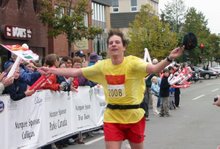
    But his age isn’t the only thing that’s special about Bain; he was diagnosed as autistic at the age of three. Today, a huge part of Alex’s motivation each time he laces up his shoes is to promote awareness about autism – and the fact that he, and many others like him, wish for acceptance, not a cure. “Autism makes me different from my friends,” says Bain. “That’s OK.” As his trademark yellow race t-shirt spells out, Bain is “Running For Autism, Not Against It.”

    In July 2006, Alex (accompanied by his mother, Janet Norman-Bain, who played both support crew and videographer) embarked on a run from tip-to-tip of PEI to raise money for autism awareness and risk and safety management. But even this challenge – he averaged between 20-25k per day – didn’t quite prepare him for what the last stretch of his marathon would feel like: Bain admits he hit the wall with 10k to go, “the first time I’ve done three hours of running.” Still, he exceeded his projected time goal by more than five minutes.

    Bain is no stranger to awards; he has also been crowned PEI RoadRunners Rookie of the Year, Junior RoadRunner of the Year and Inspirational Runner of the Year.

    ~*~

    Thank you, whoever nominated him, they didn't tell me who you are.

    I've known about this for a while now but Alex only learned about it just now when I saw it had shown up up their website and showed him. They will be sending him a copy of the magazine since we are without a Running Room or Runner's Den here (you can pick up a free copy at any Running Room or subscribe here).

    Thanks too Jessica Aldred, Associate Editor, for so nicely capturing the essence of Alex in the bio she wrote.

    Congratulations Alex!

    "I like to thanks to Stanley Chaisson for training me, Chris Brake for inspiring me, my mom for drives to races and all members from PEI Road Runner Club. Special Thanks for Dianne and Elaine for big hugs." Alex


    PEI RoadRunners Responded HERE


Monday, November 17, 2008

Autistic Teenager Runs, and Makes Strides

Autistic Teenager Runs, and Makes Strides

Published: November 14, 2008

West Hempstead

Kirk Condyles for The New York Times

Jonathan Brunot, wearing his New York City Marathon medal, with his running coach, Vincent Del-Cid.

Brightroom.com

IT took Jonathan Brunot, undeniably handsome at 19 yet so profoundly autistic that the most rudimentary attempts at communication can provoke a wild-eyed struggle, six years to learn how to tie the laces of his sneakers. It took him a lifetime to master 10 words: not just to say them, but also to grasp their meaning as he blurts them out.

Bathroom, a hygienic necessity, and rice, a favorite food, are two of his verbal accomplishments. He recognizes and repeats his own name — sometimes. He has to be in the right mood. And he usually needs prompting from a teacher (he attends the Genesis School in Plainview, where all 25 students are autistic) or a family member.

“Communication is his enemy,” is the way Vincent Del-Cid of Bayside, Jonathan’s running coach and, during long-distance training jaunts, his fleet-of-foot singing partner (“Old MacDonald” is their theme song), summarizes his protégé’s social skills. Virtually nonexistent. But it turns out his athletic ability is off the charts.

The New York City Marathon? Jonathan aced it Nov. 2 on his first attempt in 4 hours 49 minutes 20 seconds, including timeouts for a slight tantrum at Mile 22 (he refused to drink his PowerGel beverage), a slight leg cramp at Mile 23 (payback for not hydrating) and a slight fumble near the finish line (he paused to wave and scream and applaud himself when he caught sight of his tearful mother, Olga, in the bleachers).

Jonathan doesn’t know he didn’t quite nail Mr. Del-Cid’s goal of 4:30. He also doesn’t know Mr. Del-Cid’s goal for 2009 is for Jonathan to run the marathon in under four hours. Time and goals are irrelevant concepts to him. But he will surely recognize the race: It’s word No. 14 in his lexicon. “Vincent,” and “to run” are words Nos. 11 to 13.

Jonathan dressed himself in running gear and bolted down two bagels before the race, and he heard, parroted and retained a complicated new word: marathon. Or, as he gleefully mispronounced it the other day, “Malathon, malathon,” while squirming self-consciously next to his coach on a sofa in the home he shares with his oft-exhausted parents. They double as his 24/7 caretakers. Though he is much less exhausting since running liberated him and, in a sense, them.

“I want to be blunt and honest here,” said Mr. Del-Cid, an accountant who left his job as a financial analyst for Merrill Lynch because it had gotten “too depressing.” Too many clients crying, he explained, over lost investments. “Jonathan has two older brothers who are extremely successful, but what could his mother be proud of after all the hard work she put into him? I told her, ‘If you allow me to, I’ll help him run the marathon.’ ”

Olga Brunot, a nurse, told him he was crazy; then she reconsidered. “I said, ‘If you can do it, I will kiss your feet.’ ” Consider them kissed, hypothetically. “Vincent is an angel.”

Until he began training with Mr. Del-Cid, Jonathan was a hyperactive, overweight teenager trapped in the psyche of an antisocial toddler. He still plays with toys and dances alone to the “Mary Poppins” soundtrack. But he is a rail-thin running machine.

According to autismspeaks.org, the odds of a child becoming a professional athlete are 1 in 16,000, the odds of a child being given a diagnosis of autism 1 in 150. The odds of a severely autistic runner (Jonathan is at the most debilitating end of the spectrum) completing a marathon have not been tabulated, if Mr. Del-Cid’s research is accurate. Just figure it’s a rarity.

“As a runner, he’s a normal person,” said Mr. Del-Cid, 52, a member of the Queens-based Alley Pond Striders, a veteran of 20 marathons and, most important to Jonathan’s family, a volunteer coach for the Rolling Thunder Special Needs Program.

Before Jonathan was paired with Mr. Del-Cid 18 months ago, he often refused to run at all. His mother attests to that. “He became my biggest enemy when I tried to get him to run,” she said of her attempts to use the Rolling Thunder program. Not anymore.

At Mile 25, when he was yanking his shirt above his washboard abs for ventilation, a quartet of female spectators noticed the name pinned to his singlet by his coach, and hollered, “Ooh la la, Jonathan!” Inspiration? They couldn’t know he was autistic and, presumably, immune to Francophile flattery. Although, come to think of it, his parents, Haitian natives, speak with heavy French accents even if he does not.

After 26.2 miles, he celebrated with two more bagels and an autographed photo from Deena Kastor, the 2004 Olympic marathon bronze medal winner whose inscription encourages him to believe in his “wildest dreams.”

Not that running a marathon was his dream. But now it is his reality: he has a medal that proves it, even if he broke the ribbon on which it is strung. The medal meshed nicely with his Superheros T-shirt when it was time to take a photo, though getting him to smile and say “cheese” was problematic. He lost interest and wandered off.

Did Jonathan believe himself capable of running the marathon? “Of course not,” said his father, Dr. Verlaine Brunot, now so convinced of the marathon’s positive impact on Jonathan that he is training him for the bicycle phase of an Oyster Bay triathlon.

The biggest concern about Jonathan for Dr. Brunot, a pediatrician, was a marathon injury. Had Jonathan gotten hurt, he said, “my wife and I would have felt guilty for letting him run, knowing he can’t tell us if something hurts like his brothers could.”

Not that either of them ever ran a marathon. The older Brunot siblings, Verlaine and Oliver, went to Juilliard on violin scholarships before attending Duke University. Prelaw and premed. The Brunots’ joys of raising their third son got sidetracked when, at age 2 ½, he stopped calling them Mommy and Daddy and, worse, withdrew his affection.

“We had no clue that something like this was down the line for him,” Dr. Brunot said. Clinical detachment went out the window. “You are a doctor yourself and then it hits your house and you think, ‘Why me?’ At first you are in shock. Then you recalibrate yourself to being an autistic parent, a lifetime situation. But seeing him run that race, reach that level of achievement, I cannot even describe it.”

Neither can Jonathan.

After posing with his medal, he bade his visitor goodbye with a handshake, gave his mother a peck behind the ear and bounded upstairs for more “Mary Poppins.” The handshake was prompted. The kiss? His own idea.