Showing posts with label New York Times. Show all posts

Monday, November 17, 2008

Autistic Teenager Runs, and Makes Strides

Autistic Teenager Runs, and Makes Strides

Published: November 14, 2008

West Hempstead

Kirk Condyles for The New York Times

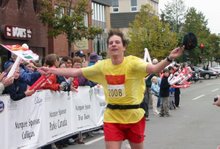
Jonathan Brunot, wearing his New York City Marathon medal, with his running coach, Vincent Del-Cid.

Brightroom.com

IT took Jonathan Brunot, undeniably handsome at 19 yet so profoundly autistic that the most rudimentary attempts at communication can provoke a wild-eyed struggle, six years to learn how to tie the laces of his sneakers. It took him a lifetime to master 10 words: not just to say them, but also to grasp their meaning as he blurts them out.

Bathroom, a hygienic necessity, and rice, a favorite food, are two of his verbal accomplishments. He recognizes and repeats his own name — sometimes. He has to be in the right mood. And he usually needs prompting from a teacher (he attends the Genesis School in Plainview, where all 25 students are autistic) or a family member.

“Communication is his enemy,” is the way Vincent Del-Cid of Bayside, Jonathan’s running coach and, during long-distance training jaunts, his fleet-of-foot singing partner (“Old MacDonald” is their theme song), summarizes his protégé’s social skills. Virtually nonexistent. But it turns out his athletic ability is off the charts.

The New York City Marathon? Jonathan aced it Nov. 2 on his first attempt in 4 hours 49 minutes 20 seconds, including timeouts for a slight tantrum at Mile 22 (he refused to drink his PowerGel beverage), a slight leg cramp at Mile 23 (payback for not hydrating) and a slight fumble near the finish line (he paused to wave and scream and applaud himself when he caught sight of his tearful mother, Olga, in the bleachers).

Jonathan doesn’t know he didn’t quite nail Mr. Del-Cid’s goal of 4:30. He also doesn’t know Mr. Del-Cid’s goal for 2009 is for Jonathan to run the marathon in under four hours. Time and goals are irrelevant concepts to him. But he will surely recognize the race: It’s word No. 14 in his lexicon. “Vincent,” and “to run” are words Nos. 11 to 13.

Jonathan dressed himself in running gear and bolted down two bagels before the race, and he heard, parroted and retained a complicated new word: marathon. Or, as he gleefully mispronounced it the other day, “Malathon, malathon,” while squirming self-consciously next to his coach on a sofa in the home he shares with his oft-exhausted parents. They double as his 24/7 caretakers. Though he is much less exhausting since running liberated him and, in a sense, them.

“I want to be blunt and honest here,” said Mr. Del-Cid, an accountant who left his job as a financial analyst for Merrill Lynch because it had gotten “too depressing.” Too many clients crying, he explained, over lost investments. “Jonathan has two older brothers who are extremely successful, but what could his mother be proud of after all the hard work she put into him? I told her, ‘If you allow me to, I’ll help him run the marathon.’ ”

Olga Brunot, a nurse, told him he was crazy; then she reconsidered. “I said, ‘If you can do it, I will kiss your feet.’ ” Consider them kissed, hypothetically. “Vincent is an angel.”

Until he began training with Mr. Del-Cid, Jonathan was a hyperactive, overweight teenager trapped in the psyche of an antisocial toddler. He still plays with toys and dances alone to the “Mary Poppins” soundtrack. But he is a rail-thin running machine.

According to autismspeaks.org, the odds of a child becoming a professional athlete are 1 in 16,000, the odds of a child being given a diagnosis of autism 1 in 150. The odds of a severely autistic runner (Jonathan is at the most debilitating end of the spectrum) completing a marathon have not been tabulated, if Mr. Del-Cid’s research is accurate. Just figure it’s a rarity.

“As a runner, he’s a normal person,” said Mr. Del-Cid, 52, a member of the Queens-based Alley Pond Striders, a veteran of 20 marathons and, most important to Jonathan’s family, a volunteer coach for the Rolling Thunder Special Needs Program.

Before Jonathan was paired with Mr. Del-Cid 18 months ago, he often refused to run at all. His mother attests to that. “He became my biggest enemy when I tried to get him to run,” she said of her attempts to use the Rolling Thunder program. Not anymore.

At Mile 25, when he was yanking his shirt above his washboard abs for ventilation, a quartet of female spectators noticed the name pinned to his singlet by his coach, and hollered, “Ooh la la, Jonathan!” Inspiration? They couldn’t know he was autistic and, presumably, immune to Francophile flattery. Although, come to think of it, his parents, Haitian natives, speak with heavy French accents even if he does not.

After 26.2 miles, he celebrated with two more bagels and an autographed photo from Deena Kastor, the 2004 Olympic marathon bronze medal winner whose inscription encourages him to believe in his “wildest dreams.”

Not that running a marathon was his dream. But now it is his reality: he has a medal that proves it, even if he broke the ribbon on which it is strung. The medal meshed nicely with his Superheros T-shirt when it was time to take a photo, though getting him to smile and say “cheese” was problematic. He lost interest and wandered off.

Did Jonathan believe himself capable of running the marathon? “Of course not,” said his father, Dr. Verlaine Brunot, now so convinced of the marathon’s positive impact on Jonathan that he is training him for the bicycle phase of an Oyster Bay triathlon.

The biggest concern about Jonathan for Dr. Brunot, a pediatrician, was a marathon injury. Had Jonathan gotten hurt, he said, “my wife and I would have felt guilty for letting him run, knowing he can’t tell us if something hurts like his brothers could.”

Not that either of them ever ran a marathon. The older Brunot siblings, Verlaine and Oliver, went to Juilliard on violin scholarships before attending Duke University. Prelaw and premed. The Brunots’ joys of raising their third son got sidetracked when, at age 2 ½, he stopped calling them Mommy and Daddy and, worse, withdrew his affection.

“We had no clue that something like this was down the line for him,” Dr. Brunot said. Clinical detachment went out the window. “You are a doctor yourself and then it hits your house and you think, ‘Why me?’ At first you are in shock. Then you recalibrate yourself to being an autistic parent, a lifetime situation. But seeing him run that race, reach that level of achievement, I cannot even describe it.”

Neither can Jonathan.

After posing with his medal, he bade his visitor goodbye with a handshake, gave his mother a peck behind the ear and bounded upstairs for more “Mary Poppins.” The handshake was prompted. The kiss? His own idea.

Saturday, November 1, 2008

This Journey Began Before Starting Line


http://www.nytimes.com/2008/11/01/sports/othersports/01marathon.html?_r=1&emc=tnt&tntemail0=y&oref=slogin

This Journey Began Before Starting Line

Rob Bennett for The New York Times Nadine McNeil will compete in her fourth marathon,but it will be the first for her 18-year-old son, Tyler, who is autistic.

Published: October 31, 2008

Nadine McNeil will reach the crest of the Verrazano-Narrows Bridge on her handcycle soon after 7:30 Sunday morning. Moments later, she will roll swiftly past her 18-year-old son, Tyler, who is autistic. This will be her fourth marathon, and Tyler’s first. She has grown uneasy this week thinking of the moment when she will leave him behind.

“I can’t look back,” she said. “For 18 years, I’ve always known every moment where Tyler is. On Sunday, I won’t.”

Though joint parent-child appearances in the New York City Marathon are not uncommon — Rod Dixon, the race’s 1983 champion, is returning this year to run the race with his daughter — the path that brought Nadine, 42, and Tyler to the marathon is an unlikely one. Nadine had a stroke when she was 8 and lost the use of her right arm and her right leg. Tyler, her only child, is severely speech-delayed. Even now at 6 feet 4 inches, he communicates verbally by using one or two words at a time.

Nadine has poured her life into her son. Tyler, in turn, is what she calls “my right arm.” He compensates for her disabilities by tying her shoes. He does her buttons and zippers. If she tries to put on her coat, he will immediately rush to her side and gently lift her right arm into the sleeve.

Neither would have ever made it to this year’s starting line without the other.

Their path to the marathon began when Tyler was 7. Nadine arrived with her son at Hunter College to see the director of Project Happy, a program that provides athletic and recreational activities to New York City youth with disabilities. Nadine was by then a single mother living in the Bronx. She had already been turned away from athletic programs at the Bronx Y, the 92nd Street Y and the 53rd Street Y because of Tyler’s tantrums and other behavior.

“He came in with his mother,” said Penny Shaw, the 71-year-old director of Project Happy. “He had no language. He did nothing but scream. We had never seen a child like that, and we certainly had never taken one into the program. But the mother was so nice, I said we would try.”

Soon after Tyler enrolled, Shaw and her staff recognized that he was a natural athlete. When he picked up a basketball, he would throw it in the hoop with almost mathematical precision. Nadine had also started taking Tyler to Achilles Kids, a running and rolling program for children with disabilities. To get him to events, she had to leave the Bronx for Manhattan at 5:30 a.m.

Tyler’s behavior began to improve during his involvement in Achilles Kids and Project Happy. He has since won dozens of medals in the Special Olympics, particularly in swimming. “This child was saved by sports,” Shaw said.

Nadine had never considered that athletics could serve a similar role in her own life. At Achilles Kids, she would guard the bags and the coats while Tyler ran. One day in August 2006, Dick Traum, an amputee who founded the Achilles adult program, mentioned to Nadine that she should consider racing in a marathon.

“I laughed,” Nadine said. “He said I could do it in a handcycle. I was like, ‘Dick, my right arm?’ ”

Three months later, in November 2006, Nadine found herself at the starting line in Staten Island. She had attached her paralyzed right arm to the handcycle’s pedal mechanism with duct tape from Home Depot. She powered the chair with her left arm and finished the marathon in 4 hours 3 minutes.

As Nadine trained for more races, Tyler would jog by her wheelchair. Nadine began to notice a difference in her supposedly frozen arm: It had gained some power and even some range of motion. Her doctor noticed, too.

“It has become much stronger in just the past year with all the practice she’s had,” said Regina Coyne, Nadine’s general practitioner.

Last November, Tyler became confused when Nadine boarded the bus to travel to the marathon starting line. He wanted to go with her. His mother convinced him to let her go by saying that he was not allowed to run the race until he was 18.

After Tyler turned 18 in July, Nadine took him to his doctor, who performed an EKG and said Tyler was physically capable.

Tyler’s school for special-needs students in the Bronx, P.S. 176, held a pep rally for him Wednesday. He marched around the seating bowl of the auditorium while holding an American flag, and his fellow students — some of them holding purple, green or orange pompoms — sang karaoke versions of “My Country ’Tis of Thee,” “We Will Rock You” and “We Are the Champions.”

One of Tyler’s friends, Sean, 19, who is also autistic, took the microphone and said solemnly: “Tyler, I have two words to say to you: Good luck at the marathon, and I love you.”

Tyler will run the race with one of his special-education teachers, Vinny Bruno. His mother has decided not to try to slow her chair and ride beside him. After 18 years, she wants to allow him to become more independent — a shift that is as difficult for her as for him.

She thinks back to when he was 3 and the doctors suggested that he would never even be toilet trained, let alone be an athlete. She has had trouble sleeping this week, mostly because she knows him so well.

“He’s going to try his hardest to get to that finish line, whether it hurts, whether it drives him nuts,” she said. “He’s going to keep coming until he sees me.”


Thursday, June 5, 2008

Real Thought for Food for Long Workouts

http://www.nytimes.com/2008/06/05/health/nutrition/05Best.html

Real Thought for Food for Long Workouts

Published: June 5, 2008

DR. MARK TARNOPOLSKY, a muscle physiology researcher at McMaster University in Canada and a physician, knows all about the exhortations by supplement makers and many nutritionists on what to eat and when to eat it for optimal performance.

The idea is that you are supposed to consume carbohydrates and proteins in a magical four-to-one ratio during endurance events like a long run or bike ride, and right after. The belief is that such nutritional diligence will improve your performance and speed your recovery.

Dr. Tarnopolsky, a 45-year-old trail runner and adventure racer, might be expected to seize upon the nutritional advice. (He won the Ontario trail running series in 2004, 2005 and 2006.)

So might his colleague, Stuart Phillips, a 41-year-old associate professor of kinesiology at McMaster who played rugby for Canada’s national team and now plays it for fun. He also runs, lifts weights and studies nutrition and performance.

In fact, neither researcher regularly uses energy drinks or energy bars. They just drink water, and eat real food. Dr. Tarnopolsky drinks fruit juice; Dr. Phillips eats fruit. And neither one feels a need to ingest a special combination of protein and carbohydrates within a short window of time, a few hours after exercising.

There are grains of truth to the nutrition advice, they and other experts say. But, as so often happens in sports, those grains of truth have been expanded into dictums and have formed the basis for an entire industry in “recovery” products.

They line the shelves of specialty sports stores and supermarkets with names like Accelerade drink, Endurox R4 powder, PowerBar Recovery bar.

“It does seem to me that as a group, athletes are particularly gullible,” said Michael Rennie, a physiologist at the University of Nottingham in England who studies muscle metabolism.

The idea that what you eat and when you eat it will make a big difference in your performance and recovery “is wishful thinking,” said Dr. Rennie, a 61-year-old who was a competitive swimmer and also used to play water polo and rugby.

Here is what is known about proteins, carbohydrates and performance.

During exercise, muscles stop the biochemical reactions used to maintain themselves such as replacing and resynthesizing the proteins needed for day to day activities. It’s not that exercise is damaging your muscles; it’s that they halt the maintenance process until exercise is over.

To do this maintenance, muscles must make protein, and to do so they need to absorb amino acids, the constituent parts of proteins, from the blood. Just after exercise, perhaps for a period no longer than a couple of hours, the protein-building processes of muscle cells are especially receptive to amino acids. That means that if you consume protein, your muscles will use it to quickly replenish proteins that were not made during exercise.

But muscles don’t need much protein, researchers say. Twenty grams is as much as a 176-pound man’s muscles can take. Women, who are smaller and have smaller muscles even compared to their body sizes, need less.

Dr. Rennie said that 10 to 15 grams of protein is probably adequate for any adult. And you don’t need a special drink or energy bar to get it. One egg has 6 grams of protein. Two ounces of chicken has more than 12 grams.

Muscles also need to replenish glycogen, their fuel supply, after a long exercise session — two hours of running, for example. For that they need carbohydrates. Muscle cells are especially efficient in absorbing carbohydrates from the blood just after exercise.

Once again, muscles don’t need much; about one gram of carbohydrate per kilogram of body weight is plenty, Dr. Tarnopolsky said. He weighs 70 kilograms, or 154 pounds, which means he would need 70 grams of carbohydrates, or say, 27 ounces of fruit juice, he said.

Asker Jeukendrup, a 38-year-old 14-time Ironman-distance finisher who is an exercise physiologist and nutritionist at the University of Birmingham in England said the fastest glycogen replacement takes place in the four hours after exercise. Even so, most athletes need not worry.

“Most athletes will have at least 24 hours to recover,” Dr. Jeukendrup said. “We really are talking about a group of extremely elite sports people who train twice a day.” For them, he said, it can be necessary to rapidly replenish muscle glycogen.

The American College of Sports Medicine, in a position paper written by leading experts, reported that athletes who take a day or two to rest or do less-intense workouts between vigorous sessions can pretty much ignore the carbohydrate-timing advice.

The group wrote that for these athletes, “when sufficient carbohydrate is provided over a 24-hour period, the timing of intake does not appear to affect the amount of glycogen stored.”

For protein, it is not clear what the window is. Some studies concluded it was less than two hours, others said three hours, and some failed to find a window at all.

Dr. Rennie and his colleagues, writing in Annual Reviews of Physiology, concluded that “a possible ‘golden period’ ” for getting amino acids into muscles “remains a speculative, no matter how attractive, the concept.”

Although studies by Dr. Jeukendrup and several others have shown that consuming protein after exercise speeds up muscle protein synthesis, no one has shown that that translates into improved performance. The reason, Dr. Jeukendrup said, is that effects on performance, if they occur, won’t happen immediately. They can take 6 to 10 weeks of training. That makes it very hard to design and carry out studies to see if athletes really do improve if they consume protein after they exercise.

“You’d have to control everything, what they do, how they train, and also their carbohydrate and protein intake,” Dr. Jeukendrup said. “Those studies become almost impossible to do.”

As for the special four-to-one ratio of carbohydrates to protein, that, too, is not well established, researchers said. The idea was that you need both carbohydrates and protein consumed together because carbohydrates not only help muscles restore their glycogen but they also elicit the release of insulin. Insulin, the theory goes, helps muscles absorb amino acids.

Insulin may stimulate muscle protein synthesis in young rodents and in human cells grown in petri dishes, Dr. Rennie said. But studies in people have shown convincingly that insulin is not required for protein synthesis in adult human beings; it is amino acids that drive protein synthesis. As yet no convincing evidence exists that a special carbohydrate-to-protein ratio makes a noticeable difference in muscle protein maintenance after exercise. “There is no magic ratio,” Dr. Jeukendrup said.

The American College of Sports Medicine is equally skeptical. “Adding protein does not appreciably enhance glycogen repletion,” its paper states.

“Some studies suggested that adding proteins to carbohydrates during exercise can enhance performance,” Dr. Tarnopolsky said. “Many other studies suggested it didn’t do any good.”

Even if there are effects of protein and carbohydrates, they are not important to most exercisers, these researchers say. Serious triathletes and elite runners, who work out in the morning and at night, need to eat between training sessions. But people who are running a few miles a few days a week don’t need to worry about replenishing their muscles, Dr. Phillips said.

Dr. Rennie agreed. “If you are a superathlete, hundredths of a second matter,” he said. “But most Joes and Janes are just kidding themselves,” he said.

Some, like Dr. Jeukendrup, say they use a commercial protein-energy drink after training hard, for convenience.

Other researchers take their own nutritional advice. Dr. Tarnopolsky has a huge glass of juice, a bagel and a small piece of meat after a two- or three-hour run. Or he might have two large pieces of toast with butter and jam and a couple of scrambled eggs. But no energy bars, no energy drinks.

Dr. Phillips might have an energy bar during a long workout. But ordinarily he does not worry about getting a special carbohydrate-to-protein mix or timing his nutrition when he exercises. Instead, Dr. Phillips said, he simply eats real food at regular meals.

New York Times Readers' Comments

What foods do you eat to fuel your workouts, or to recover from them? Share your story.

Thursday, March 27, 2008

Yes, Running Can Make You High

Yes, Running Can Make You High

Published: March 27, 2008

THE runner’s high: Every athlete has heard of it, most seem to believe in it and many say they have experienced it. But for years scientists have reserved judgment because no rigorous test confirmed its existence.

Yes, some people reported that they felt so good when they exercised that it was as if they had taken mood-altering drugs. But was that feeling real or just a delusion? And even if it was real, what was the feeling supposed to be, and what caused it?

Some who said they had experienced a runner’s high said it was uncommon. They might feel relaxed or at peace after exercising, but only occasionally did they feel euphoric. Was the calmness itself a runner’s high?

Often, those who said they experienced an intense euphoria reported that it came after an endurance event.

My friend Marian Westley said her runner’s high came at the end of a marathon, and it was paired with such volatile emotions that the sight of a puppy had the power to make her weep.

Others said they experienced a high when pushing themselves almost to the point of collapse in a short, intense effort, such as running a five-kilometer race.

But then there are those like my friend Annie Hiniker, who says that when she finishes a 5-k race, the last thing she feels is euphoric. “I feel like I want to throw up,” she said.

The runner’s-high hypothesis proposed that there were real biochemical effects of exercise on the brain. Chemicals were released that could change an athlete’s mood, and those chemicals were endorphins, the brain’s naturally occurring opiates. Running was not the only way to get the feeling; it could also occur with most intense or endurance exercise.

The problem with the hypothesis was that it was not feasible to do a spinal tap before and after someone exercised to look for a flood of endorphins in the brain. Researchers could detect endorphins in people’s blood after a run, but those endorphins were part of the body’s stress response and could not travel from the blood to the brain. They were not responsible for elevating one’s mood. So for more than 30 years, the runner’s high remained an unproved hypothesis.

But now medical technology has caught up with exercise lore. Researchers in Germany, using advances in neuroscience, report in the current issue of the journal Cerebral Cortex that the folk belief is true: Running does elicit a flood of endorphins in the brain. The endorphins are associated with mood changes, and the more endorphins a runner’s body pumps out, the greater the effect.

Leading endorphin researchers not associated with the study said they accepted its findings.

“Impressive,” said Dr. Solomon Snyder, a neuroscience professor at Johns Hopkins and a discoverer of endorphins in the 1970’s.

“I like it,” said Huda Akil, a professor of neurosciences at the University of Michigan. “This is the first time someone took this head on. It wasn’t that the idea was not the right idea. It was that the evidence was not there.”

For athletes, the study offers a sort of vindication that runner’s high is not just a New Agey excuse for their claims of feeling good after a hard workout.

For athletes and nonathletes alike, the results are opening a new chapter in exercise science. They show that it is possible to define and measure the runner’s high and that it should be possible to figure out what brings it on. They even offer hope for those who do not enjoy exercise but do it anyway. These exercisers might learn techniques to elicit a feeling that makes working out positively addictive.

The lead researcher for the new study, Dr. Henning Boecker of the University of Bonn, said he got the idea of testing the endorphin hypothesis when he realized that methods he and others were using to study pain were directly applicable.

The idea was to use PET scans combined with recently available chemicals that reveal endorphins in the brain, to compare runners’ brains before and after a long run. If the scans showed that endorphins were being produced and were attaching themselves to areas of the brain involved with mood, that would be direct evidence for the endorphin hypothesis. And if the runners, who were not told what the study was looking for, also reported mood changes whose intensity correlated with the amount of endorphins produced, that would be another clincher for the argument.

Dr. Boecker and colleagues recruited 10 distance runners and told them they were studying opioid receptors in the brain. But the runners did not realize that the investigators were studying the release of endorphins and the runner’s high. The athletes had a PET scan before and after a two-hour run. They also took a standard psychological test that indicated their mood before and after running.

The data showed that, indeed, endorphins were produced during running and were attaching themselves to areas of the brain associated with emotions, in particular the limbic and prefrontal areas.

The limbic and prefrontal areas, Dr. Boecker said, are activated when people are involved in romantic love affairs or, he said, “when you hear music that gives you a chill of euphoria, like Rachmaninoff’s Piano Concerto No. 3.” The greater the euphoria the runners reported, the more endorphins in their brain.

“Some people have these really extreme experiences with very long or intensive training,” said Dr. Boecker, a casual runner and cyclist, who said he feels completely relaxed and his head is clearer after a run.

That was also what happened to the study subjects, he said: “You could really see the difference after two hours of running. You could see it in their faces.”

In a follow-up study, Dr. Boecker is investigating if running affects pain perception. “There are studies that showed enhanced pain tolerance in runners,” he said. “You have to give higher pain stimuli before they say, ‘O.K., this hurts.’ ”

And, he said, there are stories of runners who had stress fractures, even heart attacks, and kept on running.

Dr. Boecker and his colleagues have recruited 20 marathon runners and a similar number of nonathletes and are studying the perception of pain after a run, and whether there are related changes in brain scans. He is also having the subjects walk to see whether the effects, if any, are because of the intensity of the exercise.

The nonathletes can help investigators assess whether untrained people experience the same effects. Maybe one reason some people love intense exercise and others do not is that some respond with a runner’s high or changed pain perception.

Annie might question that. She loves to run, but wonders why. But her husband tells her that the look on her face when she is running is just blissful. So maybe even she gets a runner’s high.


Sunday, June 3, 2007

Silent Running - New York Times


The Island
Silent Running
By COREY KILGANNON
Published: June 3, 2007

HICKSVILLE

BEFORE a 5-kilometer race here last weekend, a pair of 16-year-old identical twins limbered up among several hundred other runners, looking, at first glance, perfectly ordinary.

They had slim builds, sinewy legs and lean faces. Their tank tops bore their race numbers: 46 for Alex Schneider, 47 for his brother Jamie.

But closer up, one could see they were different from the runners around them. They did not speak, even when spoken to. They stared into the distance and were clingy with their parents, Alan and Robyn Schneider. Each twin wore a bracelet identifying him as having nonverbal autism and listing contact information.

They pranced distractedly on the lawn like colts, impatient to run. But by the time the competitors left the starting line on South Oyster Bay Road, both boys stared intently ahead and moved quickly — each with a running coach at his side — toward the head of the pack.

“They can focus like a laser beam,” Mr. Schneider said. “They just get in a zone from the minute they wake up on a race day.”

That zone can distress the parents of autistic children. It can keep the children prisoners of their inner world and keep everyone else out. But if applied, it can become a tool, the way some of us use anger or charm or obsession to pursue our goals.

The Schneiders were desperate for some activity for their boys to focus on — one that would bring crucial interaction with nonautistic children and allow a physical outlet for their boundless energy.

The boys would often run speedy circles in the gym of their school, the Genesis School in Plainview, founded in 1995 by a group of parents with autistic children. A school official mentioned the Rolling Thunder Special Needs Program, which helps physically and mentally challenged athletes on Long Island compete in mainstream races.

In the regular weekend races and practices, the Schneiders found focus and interaction and energy release for Alex and Jamie.

They also learned that the boys were gifted runners. Alex is beginning to challenge the best of his age group, finishing 25th out of 370 runners in February at the Snowflake four-miler in Long Beach and recently running a 10K race (6.2 miles) in 43 minutes. He beat 85 people last month to win a 5K (3.1 miles) in Great Neck.

Officials at Great Neck South High School have agreed to allow the twins to practice and compete with its varsity team come September, the Schneiders said.

Because the boys cannot follow a race course alone, each must run with a guide. But they have trouble finding guides who are fast enough. Shanthy Hughes, 39, of Floral Park, runs with Jamie. Kevin McDermott, 48, of East Islip, runs with Alex. The guides’ availability is limited, so the boys run only once a week.

At the end of each race, Alex keeps running, and Mr. McDermott has to corral him.

“He’s a running machine,” Mr. McDermott said. “He’s come so far with minimal practice, and he drops 15 seconds each race. We don’t want to push him, so we really don’t know how fast he can really go yet. We’re holding him back because he doesn’t understand pacing. He goes out too fast the first mile, because he doesn’t know when the race is going to end.”

The brothers have always excelled at certain things, including being able to quickly and methodically assemble 500-piece puzzles from the bottom up, left to right. But now, running has taken over.

“Alex races through his dinner, he races up and down the stairs,” Mrs. Schneider said. “You can’t tell them about the race the day before because they get so excited they won’t sleep. You have to tell them that morning. Then they take their sneakers and the clothing in their gym bags and line it all up.”

After they leave school at age 20, the twins will most likely live in a group home and work. “They already have jobs that make use of their compulsiveness,” Mrs. Schneider said. “They work at T. J. Maxx, unpacking boxes of merchandise and organizing it, and at an office, opening and collating mail.”

Like Alex and Jamie, their parents are also racing: in their case to prepare the boys to survive when they can no longer parent them. Running in the real world, the Schneiders hope, will teach their sons about the rewards of discipline and hard work and push them toward more independent mainstream ventures.

After last weekend’s race, other runners sprawled in exhaustion, but the Schneider twins still pranced around restlessly.

Alex had finished 86th out of nearly 400 runners, completing the five kilometers in 20 minutes 53 seconds, including a 6:30 first mile. Jamie ran the race in 27:46.

Steve Cuomo, 54, of Shirley, head coach and president of the Rolling Thunder group, came by and hugged them.

“We don’t know what kids like this can do because we’ve never trained them,” he said. “One thing I teach them is: Never quit. They’re going to survive out there in the real world.”